The Brief
In commercial drone operations, closing an enterprise agreement with a general contractor, utility company, or engineering firm feels like the ultimate validation of your business. But tucked inside the 25-page standard Master Services Agreement (MSA) provided by corporate procurement desks are legal landmines designed for heavy earthmoving equipment and general civil subcontractors�not airborne robotic systems operating under federal aviation regulations.
When an enterprise pilot signs an unedited corporate MSA, they often agree to indemnify the client against all regulatory fines, bear the financial brunt of entire jobsite work stoppages, and surrender data rights before an invoice is paid. In the eyes of corporate risk management, your $10,000 drone flight is treated with the same boundless liability as a 50-ton crane collapse.
This capstone investigation dissects the five most dangerous contractual traps in commercial UAS service agreements, explains the legal mechanisms behind cross-liability under 14 CFR Part 107, and provides the exact contract redline language every remote pilot in command (RPIC) should execute before turning a propeller.
You are handed a $45,000 annual inspection contract by a regional construction developer.
The scope of work is straightforward: bi-weekly progress mapping and stockpile volumetrics across three active commercial developments. The rates are healthy, and the client wants you on-site by next Tuesday.
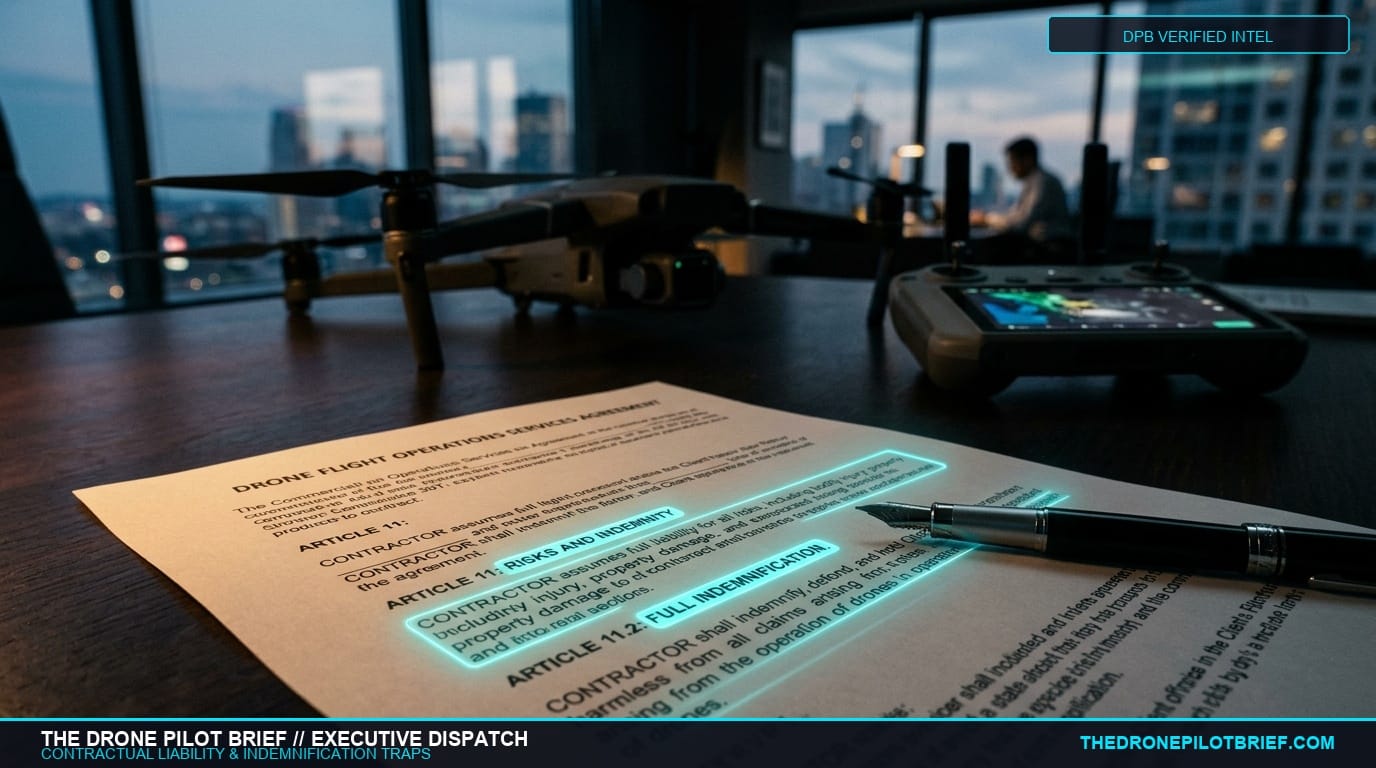
On page 18 of the client�s Master Services Agreement, under Section 11.2, is a single standard paragraph:
"Contractor shall defend, indemnify, and hold harmless Client and its affiliates from and against any and all claims, liabilities, losses, damages, fines, penalties, and expenses arising directly or indirectly out of Contractor's presence on the worksite or performance of flight operations."
You sign it. Two months later, an unannounced military medical evacuation helicopter enters your low-altitude operating area. In compliance with 14 CFR � 107.37, you immediately execute an emergency descent to yield right-of-way, landing your drone on an unfinished concrete slab. A sub-contractor�s excavator operator sees the sudden descent, swerves, and cracks a $35,000 hydraulic fluid line.
Under that unedited clause, the general contractor's insurance carrier does not pay for the hydraulic spill. You do.
1. The Uncapped Broad-Form Indemnity Trap
Corporate attorneys love broad-form indemnity because it transfers the client's own operational negligence onto the vendor. If an employee of the client trips over your tripod-mounted ground control target while checking their phone, a broad indemnity clause obligates your drone business to pay their medical bills and legal defense.
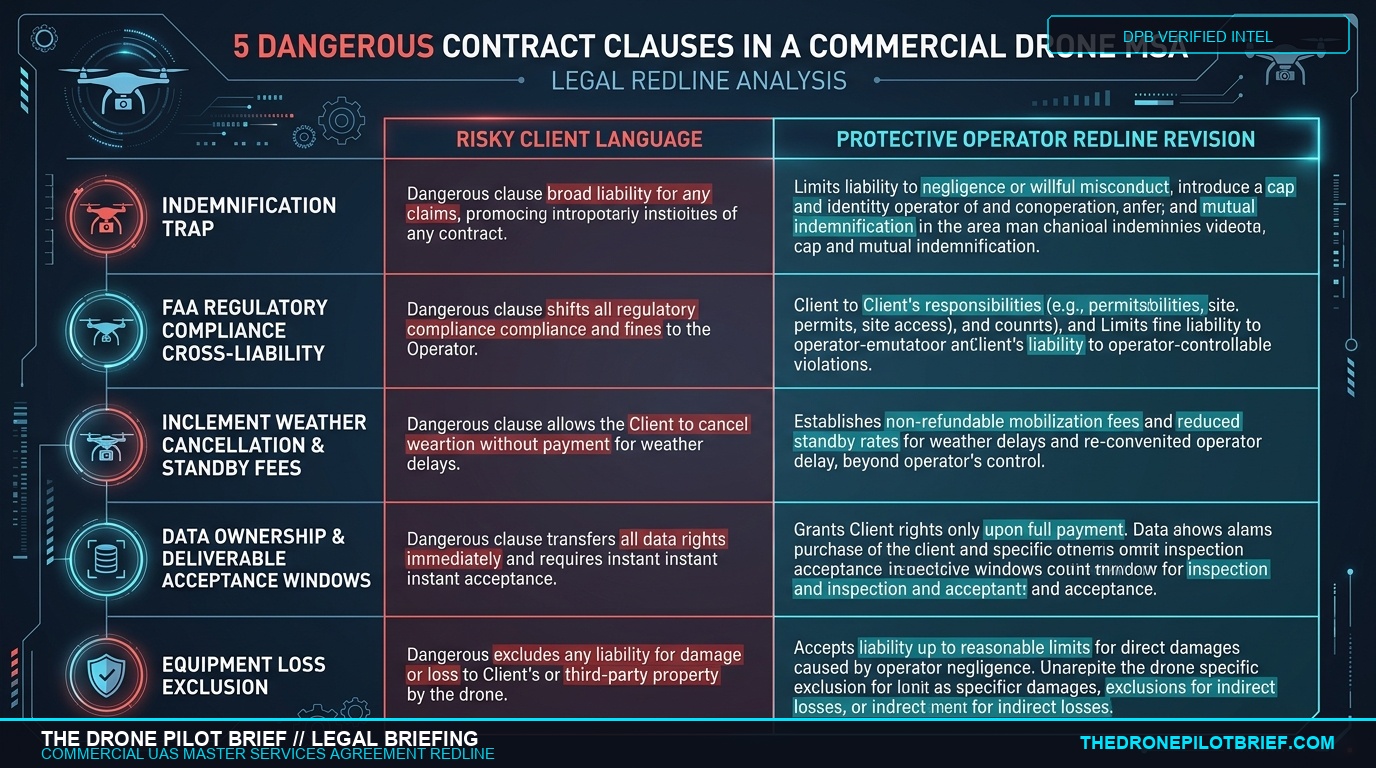
The DPB Redline Fix: Never accept broad-form indemnity. Limit indemnification strictly to claims arising directly from your sole gross negligence or willful misconduct, and mandate mutual indemnification so the client indemnifies you for hazards under their physical control.
2. Regulatory Cross-Liability & FAA Enforcement
Enterprise clients frequently include clauses stating: "Contractor guarantees full compliance with all federal, state, and local laws and assumes liability for any regulatory penalties levied against Client."
Here is the trap: under federal aviation law, the FAA regulates the airspace and enforces actions against the Remote Pilot in Command (RPIC), not the property owner. However, municipalities and state agencies increasingly pass local drone ordinances (such as California AB 2113's 400-foot stadium buffer). If a client demands that you fly inside a restricted perimeter to capture a marketing shot, they can theoretically trigger a municipal citation and pass the fine back to you under the contract.
The DPB Redline Fix: Insert an explicit Aviation Authority & Airspace Precedence Clause:
"Client acknowledges that the Remote Pilot in Command (RPIC) maintains exclusive, non-negotiable operational authority over all flight operations pursuant to 14 CFR � 107.19. The RPIC reserves the absolute right to refuse, delay, or abort any flight deemed unsafe or in violation of federal aviation regulations, without incurring breach of contract or financial penalty."
3. Weather Cancellations & Standby Demurrage
Civil contractors operate under strict milestone schedules. If rain, 28-knot wind gusts, or cloud ceilings below 500 feet prevent safe Part 107 operations, clients often claim the flight was "not performed" and refuse to pay mobilization expenses.
The DPB Redline Fix: Establish a clear Weather Demurrage & Re-Flight Policy. If the RPIC grounds the aircraft due to conditions exceeding manufacturer envelopes or FAA weather minimums (14 CFR � 107.51), the client is billed a non-refundable 50% mobilization fee, with a guaranteed priority re-flight window.
4. Data Ownership & Conditional Deliverable Rights
Standard client contracts often dictate: "All intellectual property, raw telemetry, orthomosaics, and media become the exclusive property of Client immediately upon capture."
If a client disputes an invoice 60 days later, they already hold the high-resolution 3D point cloud and have integrated it into their CAD software. You have lost all commercial leverage.
The DPB Redline Fix: Include a Conditional Title Clause stating that full copyright and commercial license to data deliverables transfer to the client only upon receipt of payment in full.
5. Equipment Loss and Site Hazard Disclaimers
If an unmapped utility wire, active crane boom, or RF jammer brings down your $20,000 LiDAR aircraft inside a secure refinery, standard MSAs disclaim all property liability.
The DPB Redline Fix: Mandate that the client provide verified, up-to-date site hazard maps prior to flight and warrant that all heavy machinery within the designated flight volume remains stationary during active grid passes.
Flight-Ready Breakdown
1. What Changed
Commercial enterprise clients are subjecting drone operators to standard heavy-construction Master Services Agreements containing uncapped indemnification, immediate IP transfer, and zero weather protection clauses.
2. Who is Affected
Commercial drone service providers (DSPs), aerial survey teams, and independent Part 107 remote pilots negotiating multi-flight commercial contracts with enterprise general contractors and engineering firms.
3. Why it Matters
A single indemnification claim from a third-party jobsite injury can bankrupt an independent drone business, even when the drone was operating fully within federal safety guidelines.
4. Before Next Mission
- Redline Section 11 Indemnity: Strike any language demanding indemnification for "any and all claims" and insert a strict "sole gross negligence" cap.
- Enforce the RPIC Authority Clause: Ensure the contract explicitly codifies the pilot's legal duty under 14 CFR � 107.19 to abort flights for safety without breach.
- Tie Data Rights to Invoices: Never deliver full un-watermarked high-resolution point clouds without contract terms tying ownership to invoice clearance.
5. What Not to Assume
- Do not assume your aviation hull insurance covers contractual liability: Aviation liability policies specifically exclude liability assumed voluntarily under contract (contractual indemnification) unless specifically endorsed.
- Do not assume procurement will reject your redlines: Enterprise legal teams expect professional vendors to redline standard boilerplate contracts; accepting without review signals inexperience.
Primary Sources & References

Related Briefs

Moving from One-Off Job Bids to Recurring Retainers: The Annual Drone Inspection Agreement
Tired of the feast-or-famine cycle of one-off mapping gigs? Here is how to package multi-quarter asset monitoring retainers for solar, roofing, and construction clients that generate predictable monthly recurring revenue....

UAS Commercial Insurance: Part 107 Guide
Operating a drone business without liability insurance is an unacceptable risk. Compare annual policies and on-demand options....

Pricing Your Mapping Services: A Practical Guide
Calculate cost-of-goods-sold (COGS), airspace complexity risk, and volume margins for survey contracts....
Get The Preflight
The weekly operational-intelligence briefing for drone pilots. Filtered down to what actually matters before your next mission.