Independent Field Rigor for Commercial UAS
In commercial unmanned aviation, procurement decisions cannot rely on manufacturer marketing claims or sponsored influencer unboxings. When enterprise Chief Pilots, civil surveying firms, and utility operators invest $10,000 to $80,000 into aerial robotics, they require repeatable, empirical data derived under real-world operational stress.
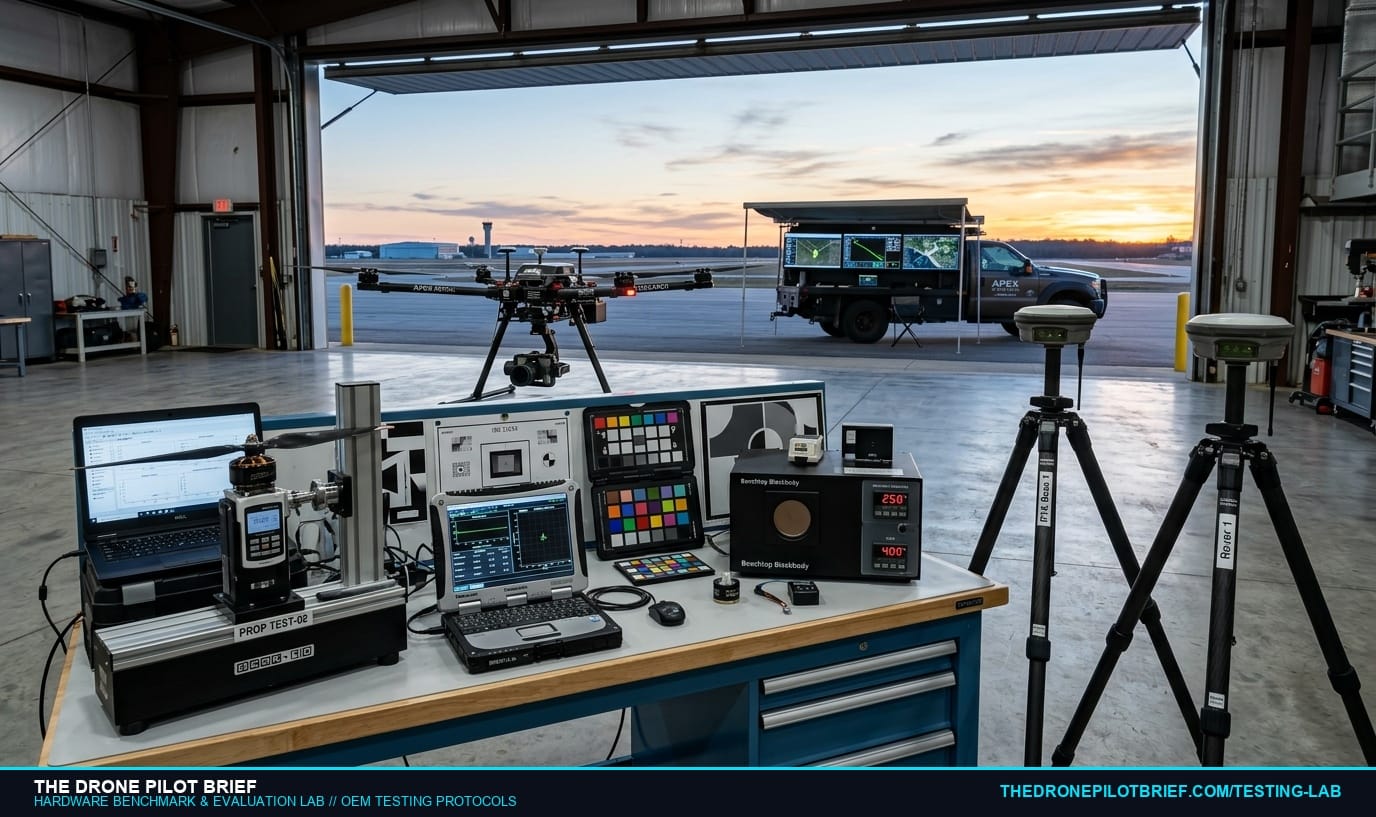
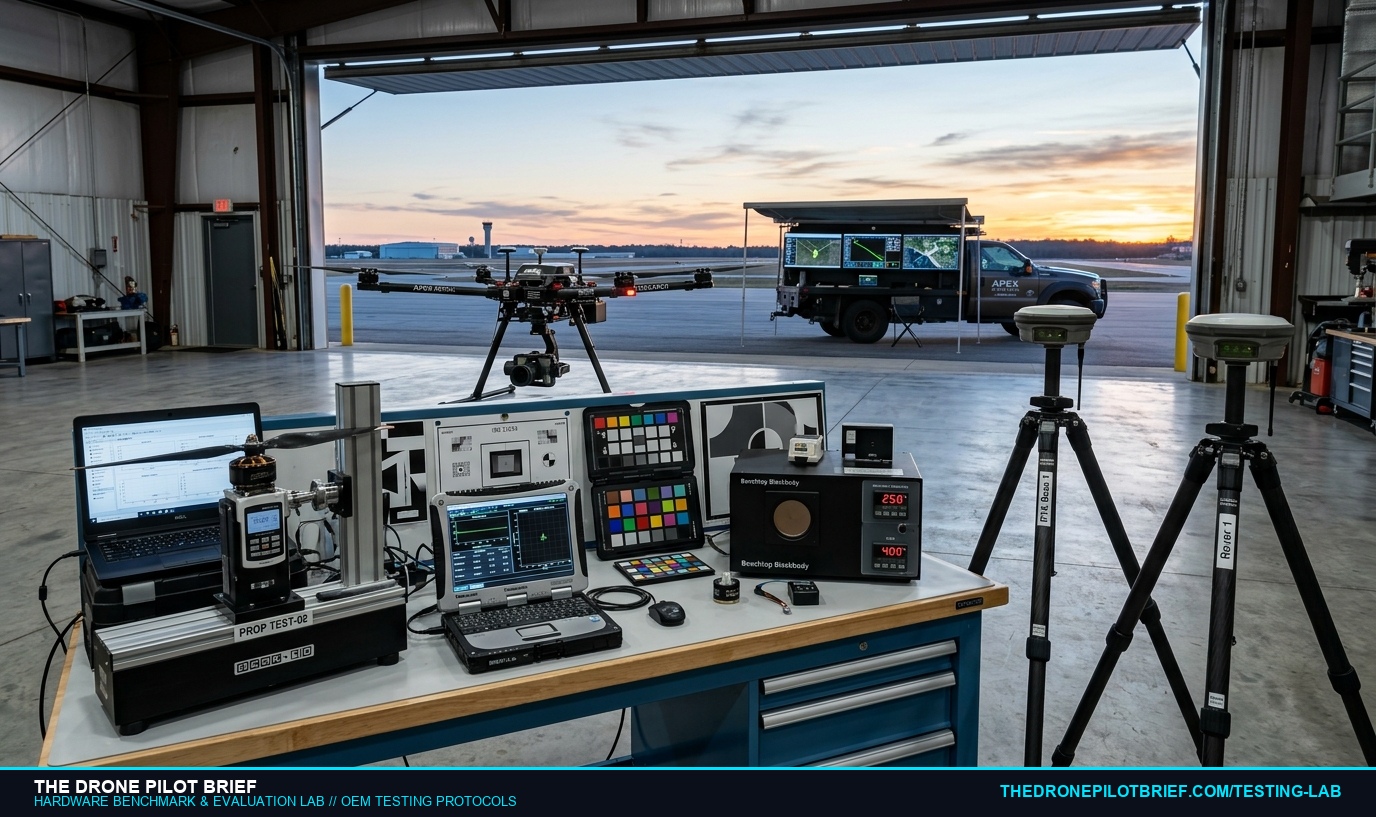
The Drone Pilot Brief Hardware & Sensor Testing Lab operates as an independent evaluation authority. We benchmark commercial uncrewed aircraft systems (UAS), multispectral and radiometric thermal sensors, GNSS differential receivers, and airborne LiDAR payloads against standardized federal, ASTM, and ASPRS engineering tolerances.
Our Four Evaluation Pillars
1. GNSS & Geodetic Precision
Centimeter-level benchmarking across high-multipath urban canyons, open-pit quarry high-walls, and remote cellular fringe corridors. We measure Horizontal/Vertical RMS accuracy, Time to First Fix (TTFF), and false integer fix resilience against certified NGS OPUS ground monuments.
Standard: ASPRS Class I/II Positional Accuracy2. Radiometric & Optical Sensors
Measurement Spot Size Ratio (SSR), thermal drift calibration (NUC), and 3×3 pixel core resolution audits for solar PV and roof diagnostics. Full sensor readout latency benchmarking (rolling vs. global shutter) across high-speed transit passes.
Standards: IEC 62446-3 | ASTM C10603. Aerodynamic & Battery Physics
High-wind envelope modeling, headwind drag coefficients ((C_d)), voltage sag curves, and amp-draw spikes. We determine the mathematical Point of No Return (PNR) under sustained 15-to-25 knot crosswind and headwind return legs.
Telemetry: Dual-channel high-rate bus logging4. C2, Cellular & Remote ID Security
RF spectrum analysis, cellular 4G/5G C2 latency, direct vs. network Remote ID broadcast packet health (ASTM F3411-22), and telemetry link robustness in congested electronic environments.
Standard: ASTM F3411-22 / 14 CFR Part 89Featured Testing Lab Benchmarks
The Commercial GNSS Benchmark: Local RTK Base Stations vs. Network NTRIP in High-Multipath Environments
Empirical fixed-baseline accuracy testing across quarry high-walls and cellular fringe corridors.
Radiometric Sensor AuditThermal Resolution in the Field: 320 vs. 640 Radiometric Cores and the Math of Critical Audits
Calculating Spot Size Ratio (SSR) and maximum flight ceiling for certified PV audits.
Sensor Readout BenchmarkRolling Shutter vs. Global Shutter at Speed: The Geometric & Cinematic Sensor Benchmark
Measuring CMOS line readout speeds against 3D photogrammetric reprojection errors.
Manufacturer & OEM Review Protocol
We welcome hardware evaluation requests from uncrewed aircraft manufacturers, sensor developers, and payload engineering teams. To maintain our editorial independence and credibility with our readership, all hardware evaluations adhere to the following non-negotiable principles:
- Strict Editorial Autonomy: The Drone Pilot Brief does not accept paid compensation, sponsored placement, or pre-publication approval rights for hardware reviews or benchmarks.
- Reproducible Methodology: All bench tests, flight envelopes, and sensor readings are published with documented environmental conditions, telemetry logs, and control monuments.
- Loan Units Only: Evaluation units are tested over a 30-to-60 day evaluation cycle and returned to the manufacturer upon completion of the test program.
Submit Hardware for Evaluation:
Direct all hardware review inquiries, technical whitepapers, and review unit dispatch requests to our editorial engineering desk: