The Brief
In high-stakes commercial drone missions�whether certifying topographic grading on a $50M civil project, auditing utility-scale solar arrays for warranty claims, or executing cinema tracking passes�relying on default ground control station defaults invites catastrophic deliverable errors.
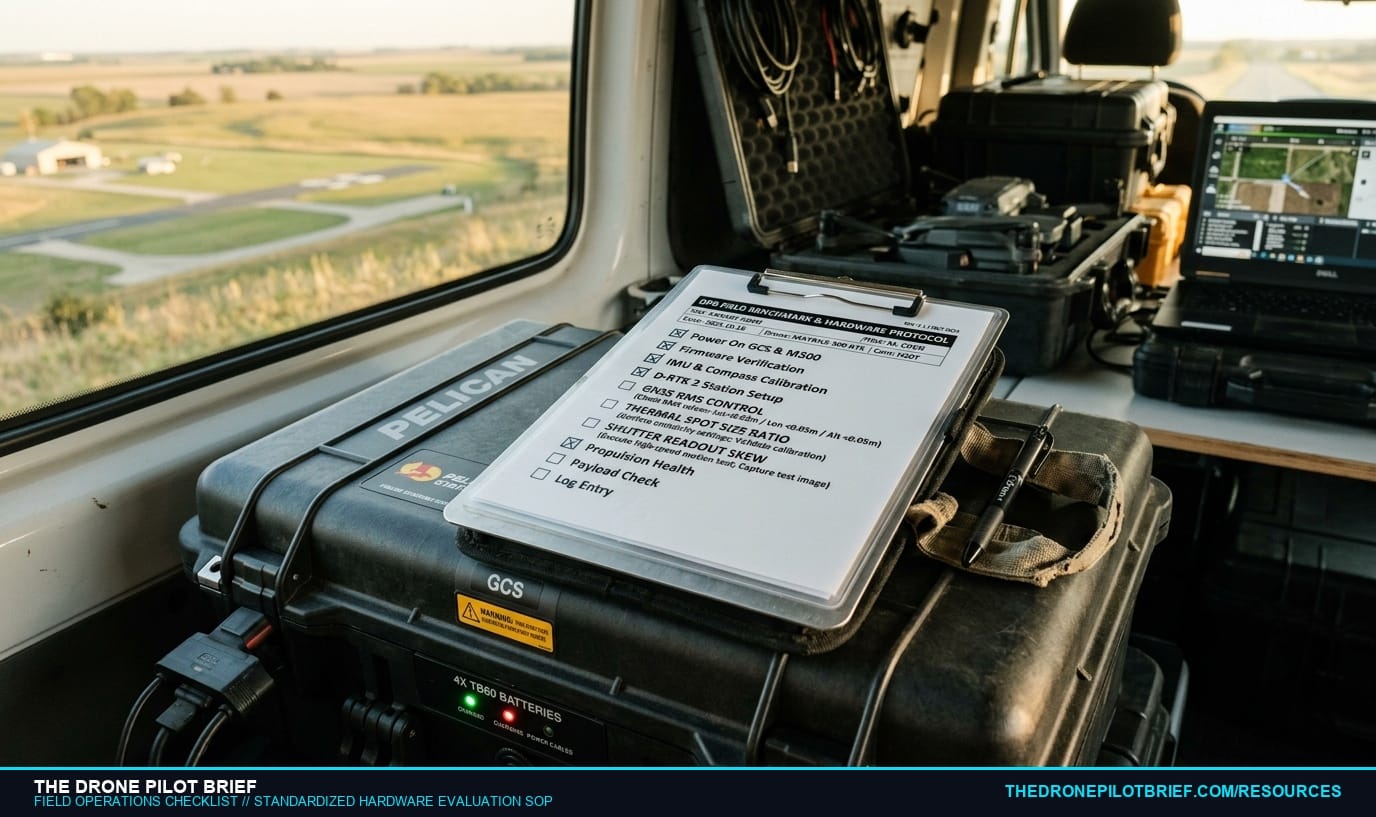
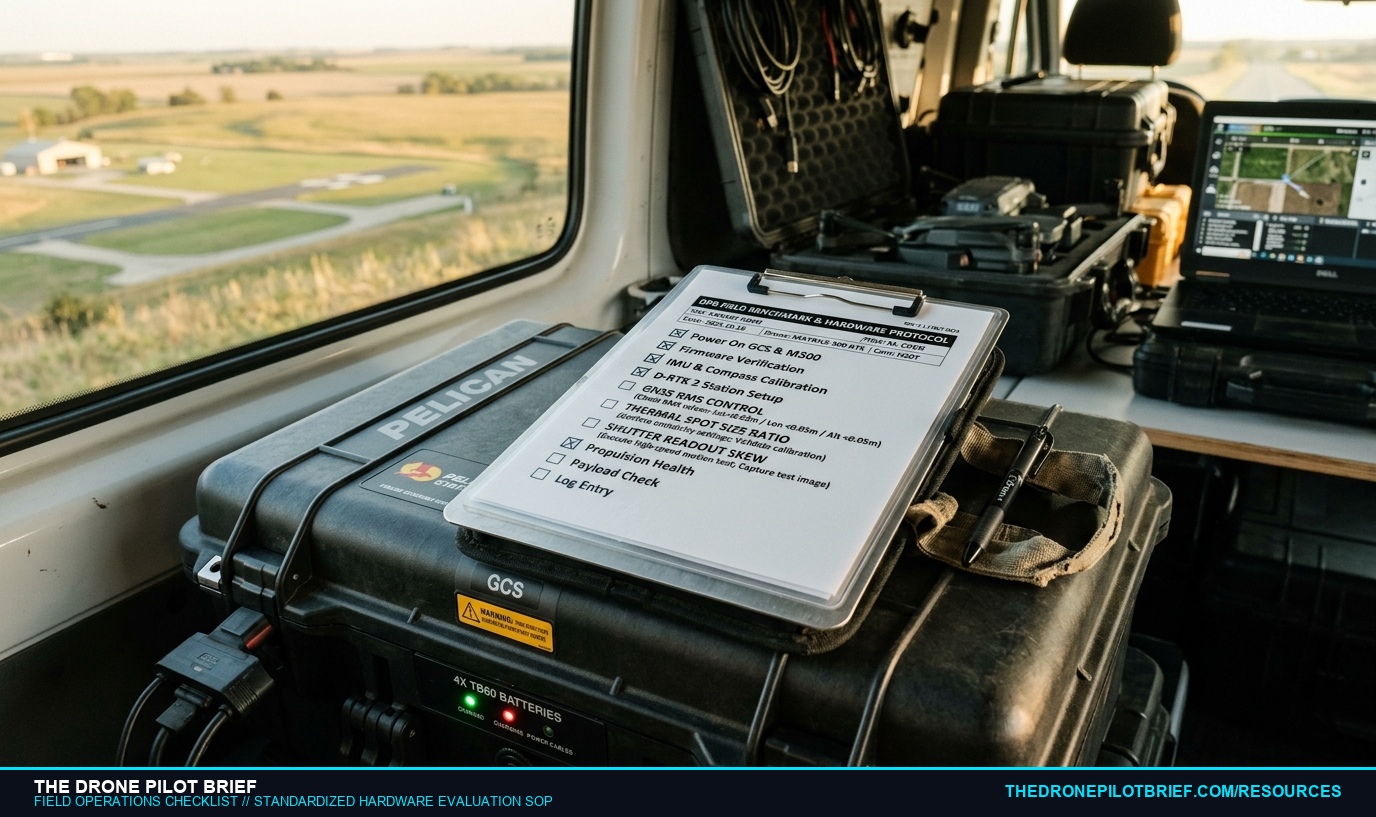
As part of our Hardware & Sensor Testing Lab initiative, The Drone Pilot Brief is releasing our internal Standard Operating Procedure (SOP) Kneeboard Checklist. Designed for field clipboard mounting or tablet reference, this protocol prevents false integer RTK fixes, thermal sensor pixel averaging, and rolling shutter geometric skew before your props leave the pad.
Field Hardware Verification Protocol
I. Geodetic & GNSS RTK Integrity
- [ ] Baseline Radio Link Check: Confirm physical base station 900MHz/UHF link age is < 1.0 second. If using cellular NTRIP, verify Age of Differential Corrections is strictly < 1.5 seconds.
- [ ] Checkpoint Validation: Place rover on a known physical benchmark monument prior to flight. Verify horizontal delta is < 1.5 cm and vertical elevation delta is < 2.5 cm.
- [ ] Multipath Obstruction Scan: Confirm PDOP is < 1.8 and satellite constellation count exceeds 22 tracking satellites across at least three constellations (GPS, GLONASS, Galileo, BeiDou).
II. Radiometric Thermal Calibration
- [ ] NUC Thermal Drift Reset: Perform Non-Uniformity Correction (NUC) after reaching flight altitude and allowing detector temperature to stabilize for 3 minutes.
- [ ] Measurement Spot Size Ratio (SSR): Verify flight altitude maintains a minimum 3×3 contiguous pixel footprint over the smallest expected defect (e.g., max 36 ft AGL for a 30mm solar diode on a 640 sensor).
- [ ] Emissivity Metadata Check: Confirm surface emissivity (ε) and background reflected temperature parameters are entered into the radiometric R-JPEG header before mission start.
III. Optical Shutter & Aerodynamic Safety
- [ ] Mechanical Shutter Verification: If capturing photogrammetry, ensure physical leaf shutter is enabled. If flying rolling shutter, cap forward transit speed below 7 m/s to restrict line readout skew.
- [ ] ND Filter & 180-Degree Shutter: For cinema passes under 50 ft AGL, install ND16/ND32 to lock 1/48s shutter. For high-altitude 400 ft sweeps, remove heavy ND to allow 1/120s shutter to preserve edge sharpness.
- [ ] Headwind RTH Battery Buffer: Measure surface wind speed. If headwind exceeds 15 knots, increase Return-to-Home (RTH) reserve threshold to 50% battery to account for cubic aerodynamic drag power losses.
Flight-Ready Breakdown
1. What Changed
Commercial drone missions increasingly fail not due to piloting errors, but due to unverified automated sensor telemetry (false RTK fixes, pixel averaging, and voltage sag).
2. Who is Affected
Commercial Part 107 pilots, enterprise survey crews, industrial thermographers, and directors of photography executing contract deliverables.
3. Why it Matters
Contract defensibility and hull safety. Five minutes spent validating benchmarks on the ground saves hours of office processing disputes or emergency forced landings.
4. Before Next Mission
- Save or print this SOP protocol to your field equipment clipboard.
- Always shoot a physical ground benchmark before launching an automated survey grid.
- Perform a manual NUC calibration every time ambient air temperature shifts by more than 5°C.
5. What Not to Assume
- Do not assume green telemetry on your controller guarantees data truth.
- Do not assume manufacturer automated RTH will successfully penetrate gusting 25-knot headwinds without manual throttle management.

Related Briefs
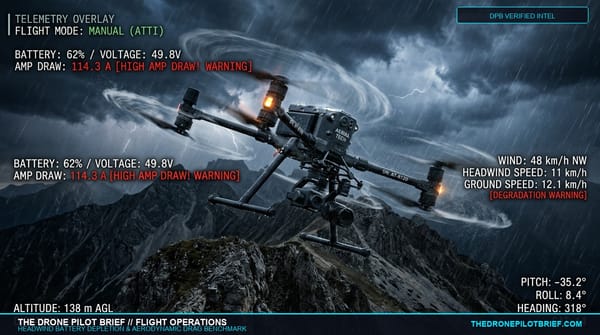
High-Wind Envelope Modeling: Ground Speed vs. Airspeed and the Physics of Headwind Battery Depletion Curves
Flying downwind is effortless; returning against a 25-knot headwind spikes amp draw exponentially. Here is the aerodynamic drag math and battery depletion curve that causes sudden forced landings�and how to calculate your true point of no return....
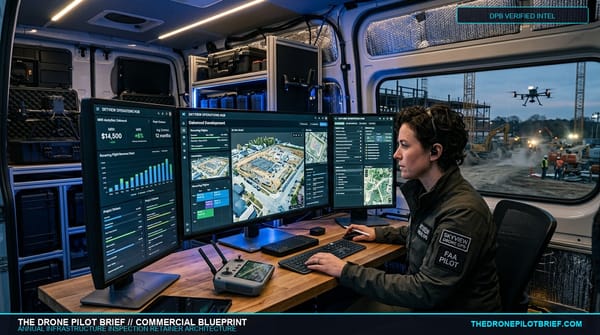
Standard Cockpit Callouts: Crew Resource Management for Two-Person Remote Pilot Teams
Crew miscommunication is the silent driver of enterprise drone accidents. Here is the standardized verbal callout protocol between Remote Pilot in Command (RPIC) and Visual Observer (VO) that prevents airspace conflicts and collision hazards....
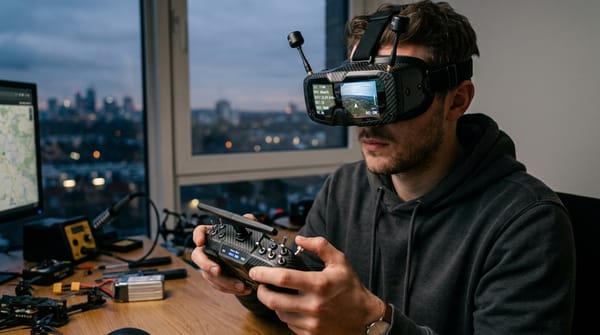
Why FPV training starts in a simulator — and cannot end there
A simulator is a cheap place to fail at an unfamiliar stick. It is not proof you can fly the aircraft you will take to a job. Treat simulation as a gate for basic control, then prove the same maneuvers on the real airframe....
Get The Preflight
The weekly operational-intelligence briefing for drone pilots. Filtered down to what actually matters before your next mission.