The Brief
In crewed airline operations, Crew Resource Management (CRM) has saved more lives over the past 40 years than any mechanical safety innovation. Standardized verbal callouts, sterile cockpit rules, and structured challenge-response protocols ensure that junior first officers and senior captains operate with seamless situational awareness.
In commercial unmanned aviation, however, multi-person crew operations are often chaotic. When complex Part 107 operations require a designated Remote Pilot in Command (RPIC) and one or more Visual Observers (VOs)�particularly for BVLOS waivers, night operations, or flights over people�communication is frequently informal, vague, and dangerously delayed.
This operational standard codifies the essential verbal callout vocabulary, sterile launch protocols, and emergency conflict procedures for two-person commercial UAS flight crews. Implementing these SOPs eliminates ambiguity and elevates your flight operations to airline-grade airmanship.
"Hey... look out, there's a plane somewhere over there!"
Those ten frantic words from an untrained visual observer have caused more near-midair collisions than actual equipment malfunctions.
The pilot's eyes are glued to a high-resolution inspection monitor. Where is "over there"? What altitude? What bearing? Is it climbing or descending?
By the time the pilot lifts their head, scans the horizon, and finds the intruder, a low-flying agricultural crop-duster has already closed the distance at 140 knots.
Professional aviation does not tolerate conversational guesswork. Professional crews speak in precise standard callouts.
The Clock-Code Standard for Airspace Intruders
Never describe traffic with relative hand gestures. Use the standard four-point callout:
[TARGET] + [CLOCK POSITION] + [ALTITUDE/TREND] + [PROXIMITY].
Example: "Traffic, low-wing Cessna, 2 o'clock, level at 500 feet, 1 mile closing."
1. The Five Essential Crew Flight Callouts
| Flight Phase | Originator | Standard Callout | Required Response / Action |
|---|---|---|---|
| Pre-Arm / Spinup | RPIC | "Arming motors. Clear prop." | VO visually verifies pad is sterile: "Pad is clear. Airspace clear." |
| Airspace Conflict | VO | "TRAFFIC, Helicopter, 10 o'clock, descending, closing fast." | RPIC acknowledges and acts: "Visual / Yielding right-of-way, descending to 50 feet." |
| Visual Line of Sight | VO | "Blind. Lost visual contact." | RPIC halts forward flight immediately: "Holding in place. Climbing 30 feet." |
| Critical Voltage | RPIC | "Low battery, 25%. Aborting grid, returning home." | VO confirms clear approach path: "Inbound corridor clear. Landing zone secure." |
| Touchdown | RPIC | "Touchdown. Motors disarmed." | VO approaches pad for battery swap: "Aircraft safe." |
2. The "Sterile Cockpit" Rule Under 50 Feet
In FAA Part 121 airline rules, non-essential conversation is strictly banned below 10,000 feet. For commercial UAS crews, adopting a **Sterile Launch & Recovery Window**�banning client chit-chat, phone calls, and secondary tasks during takeoff, climb to 50 feet, and the final 50-foot descent�eliminates 80% of ground-level obstacle strikes.
Flight-Ready Breakdown
1. What Changed
Commercial drone operations have expanded into multi-crew environments (BVLOS waivers, night flights, infrastructure inspections) without adopting standardized aviation verbal callouts.
2. Who is Affected
Enterprise flight leads, remote pilots in command (RPICs), and visual observers (VOs) executing complex commercial missions under 14 CFR Part 107.
3. Why it Matters
Midair safety and professional liability. Casual, imprecise communication delays defensive maneuvers when crewed aircraft infringe low-altitude airspace.
4. Before Next Mission
- Brief the Crew Callouts: Review the clock-code traffic protocol with your Visual Observer before powering up the ground station.
- Enforce the Sterile Zone: Instruct on-site clients that approaching the RPIC during takeoff and landing is prohibited for flight safety.
- Designate an Emergency Abort Zone: Agree on a designated clear turf or gravel patch where the drone will be ditched if an unannounced aircraft forces an immediate emergency descent.
5. What Not to Assume
- Do not assume your VO knows what to look for: Visual observers without aviation training naturally watch the drone; their legal duty under � 107.33 is to scan the *surrounding airspace* for intruders.
- Do not assume the pilot has visual contact while monitoring telemetry: When conducting precision sensor audits, the RPIC is heads-down on the screen; the VO is the primary line of defense.
Primary Sources & References

Related Briefs
The DPB Field Benchmark SOP: Pre-Flight Geodetic & Sensor Verification Checklist
Never fly an unverified payload. Here is the standardized 10-point field checklist used by the DPB Field Lab to verify GNSS RTK integer fixes, radiometric thermal calibration, and shutter readout skew....
High-Wind Envelope Modeling: Ground Speed vs. Airspeed and the Physics of Headwind Battery Depletion Curves
Flying downwind is effortless; returning against a 25-knot headwind spikes amp draw exponentially. Here is the aerodynamic drag math and battery depletion curve that causes sudden forced landings�and how to calculate your true point of no return....
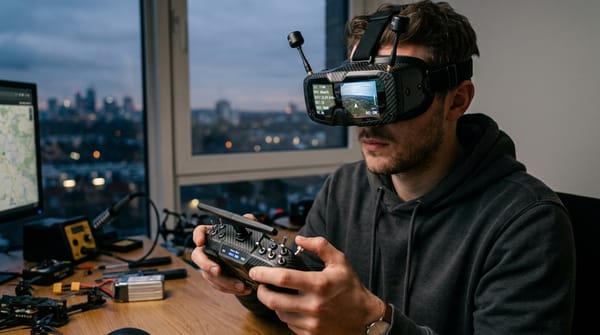
Why FPV training starts in a simulator — and cannot end there
A simulator is a cheap place to fail at an unfamiliar stick. It is not proof you can fly the aircraft you will take to a job. Treat simulation as a gate for basic control, then prove the same maneuvers on the real airframe....
Get The Preflight
The weekly operational-intelligence briefing for drone pilots. Filtered down to what actually matters before your next mission.