Updated: 3 September 2026
The Brief
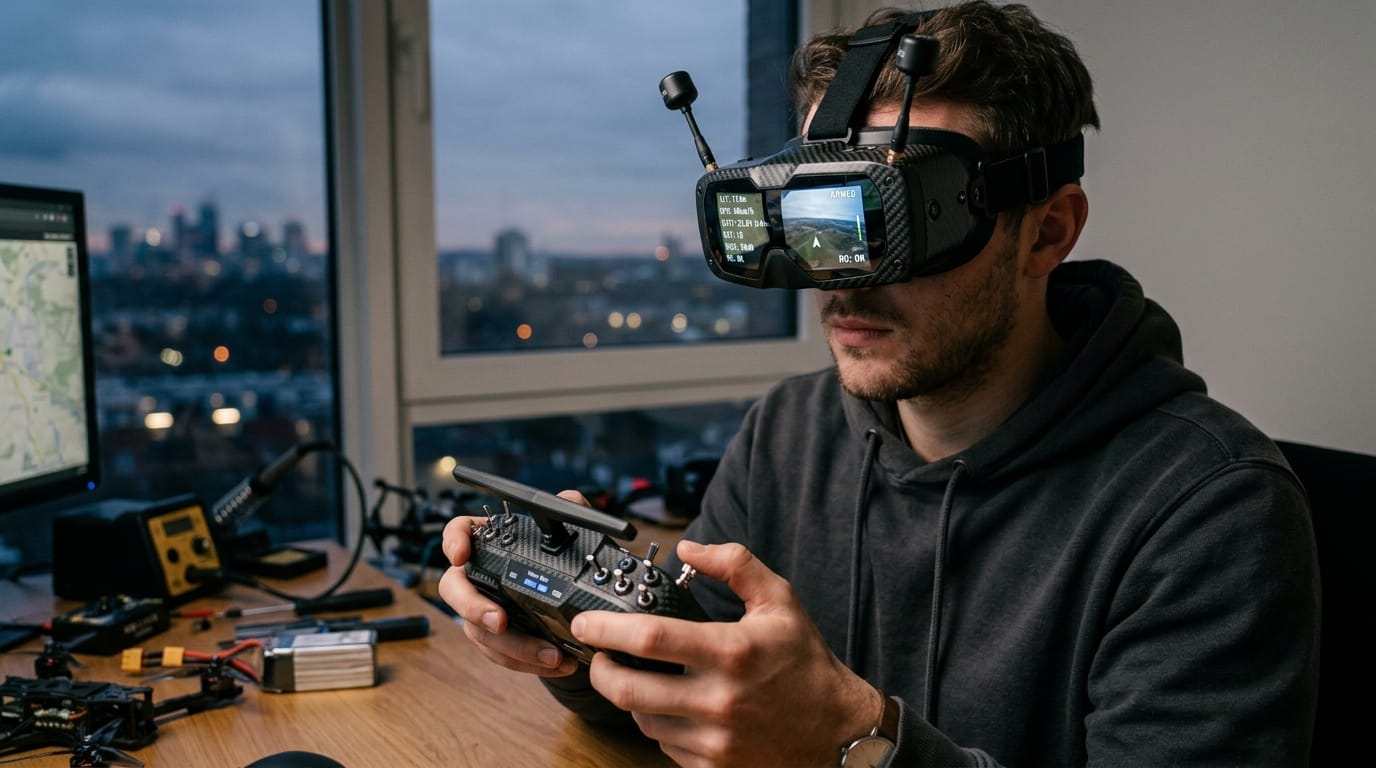
A simulator is a cheap place to fail at an unfamiliar stick. It is not proof you can fly the aircraft you will take to a job. Treat simulation as a gate for basic control, then prove the same maneuvers on the real airframe, in the conditions you actually work in.
That is the useful civilian takeaway from military FPV courses that put students on desktops before live aircraft. It is not a syllabus you can copy, and it is not a Part 107 workaround.
Flight-Ready Breakdown
Training SyllabusWhat Changed
Nothing in Part 107. FPV goggles do not replace visual line of sight. If you cannot see the aircraft yourself, you need a visual observer who can, in communication with you, under 14 CFR §§ 107.31 and 107.33 — unless you have a waiver that says otherwise.
Who is Affected
Part 107 operators adding FPV for inspection, cinema, or public-safety work; anyone selling “simulator hours” as if they were a rating.
Why it Matters
Most early FPV wrecks are basic handling errors (wrong yaw, over-control, lost orientation) that a sim will absorb. Wind, latency, glare, a dying video link, and a real propeller do not exist in the box. Counting sim hours instead of checking live performance is how you convert a training aid into a false currency.
Before Next Mission
Write down three maneuvers the job actually needs. Pass them in the sim without crashing. Repeat them on the aircraft in a sterile area, with a VO if the goggles are on, until the pass/fail is obvious. Then fly the job profile. Do not skip the live gate because the sim log looks busy.
What Not to Assume
Do not assume Army or other DoD FPV courses authorize civilian BVLOS, operations over people, or night work. Do not assume a consumer sim models your airframe’s failsafe or your site’s RF. Do not assume “I have a VO on Discord” meets § 107.33.
What a Civilian Program Can Steal
Use the sim for skills that are new and expensive to break in hardware: coordinated FPV camera view, punch-outs, recoveries from unusual attitudes. Score attempts, don’t count hours. When you move to the aircraft, score the same attempts again. If live scores collapse, you are not trained — the sim just got you to the field.
Keep a dedicated observer who can see the aircraft when you cannot. Brief lost-link, lost-video, and “I am transferring controls” before arming. Those are crew procedures, not sim settings.
What We Are Not Claiming
We are not certifying any commercial sim, school, or Army course. We have not been to UALC. Public military descriptions of virtual familiarization before live FPV are a pattern, not a data set we independently audited. If you need the military primary, read it there; do not fly on our paraphrase.
Bottom Line
Sim, then aircraft, then the job. The middle step is the one people skip.
Sources
- • 14 CFR § 107.31: Visual line of sight aircraft operation — https://www.ecfr.gov/current/title-14/section-107.31
- • 14 CFR § 107.33: Visual observer — https://www.ecfr.gov/current/title-14/section-107.33
- • 14 CFR § 107.39: Operation over human beings (if the profile includes it) — https://www.ecfr.gov/current/title-14/section-107.39
Unlinked “UALC briefing,” NIST “2026 simulation frameworks,” and a generic LAANC/LiPo checklist were removed from this page because they were not shown as supporting the lede. If those documents are brought back, they need URLs and a sentence that actually uses them. This version explicitly supersedes DPB-PILOT-001 v1.0.
The Drone Pilot Brief does not accept payment for editorial coverage.

Related Briefs
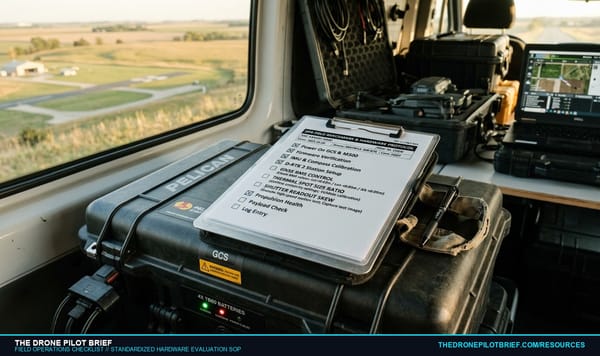
The DPB Field Benchmark SOP: Pre-Flight Geodetic & Sensor Verification Checklist
Never fly an unverified payload. Here is the standardized 10-point field checklist used by the DPB Field Lab to verify GNSS RTK integer fixes, radiometric thermal calibration, and shutter readout skew....
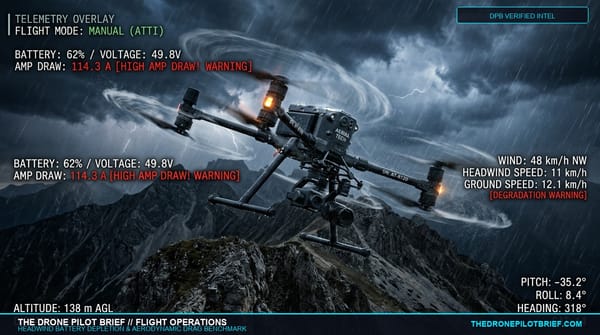
High-Wind Envelope Modeling: Ground Speed vs. Airspeed and the Physics of Headwind Battery Depletion Curves
Flying downwind is effortless; returning against a 25-knot headwind spikes amp draw exponentially. Here is the aerodynamic drag math and battery depletion curve that causes sudden forced landings�and how to calculate your true point of no return....
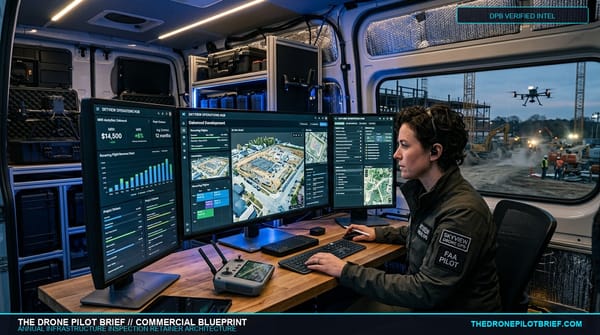
Standard Cockpit Callouts: Crew Resource Management for Two-Person Remote Pilot Teams
Crew miscommunication is the silent driver of enterprise drone accidents. Here is the standardized verbal callout protocol between Remote Pilot in Command (RPIC) and Visual Observer (VO) that prevents airspace conflicts and collision hazards....
Get The Preflight
The weekly operational-intelligence briefing for drone pilots. Filtered down to what actually matters before your next mission.