The Brief
In both high-end aerial cinematography and engineering-grade photogrammetry, the camera sensor is the ultimate arbiter of fidelity. Yet while drone manufacturers tout megapixels, sensor sizes (1-inch vs. Micro Four Thirds vs. Full Frame), and dynamic range in stops, they almost never publish their sensor's line-by-line sensor readout speed.
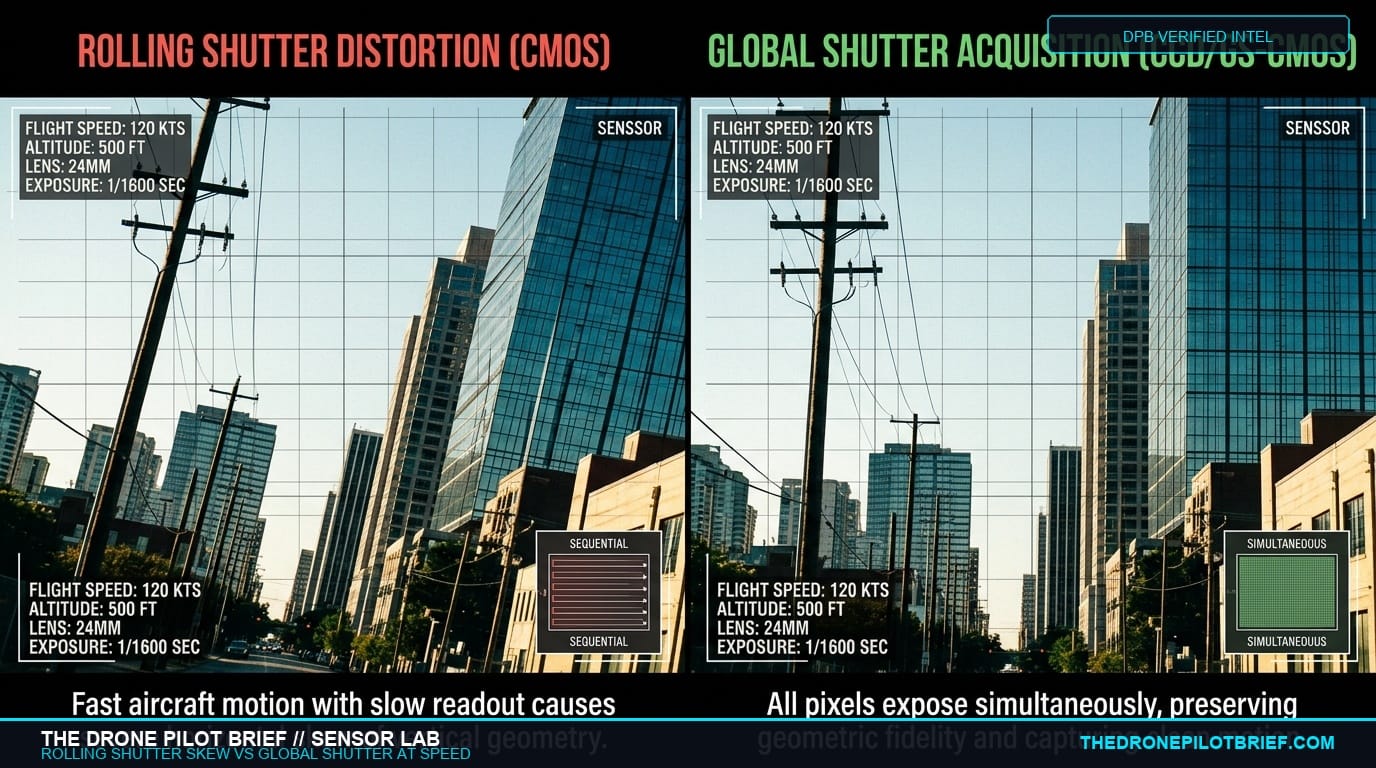
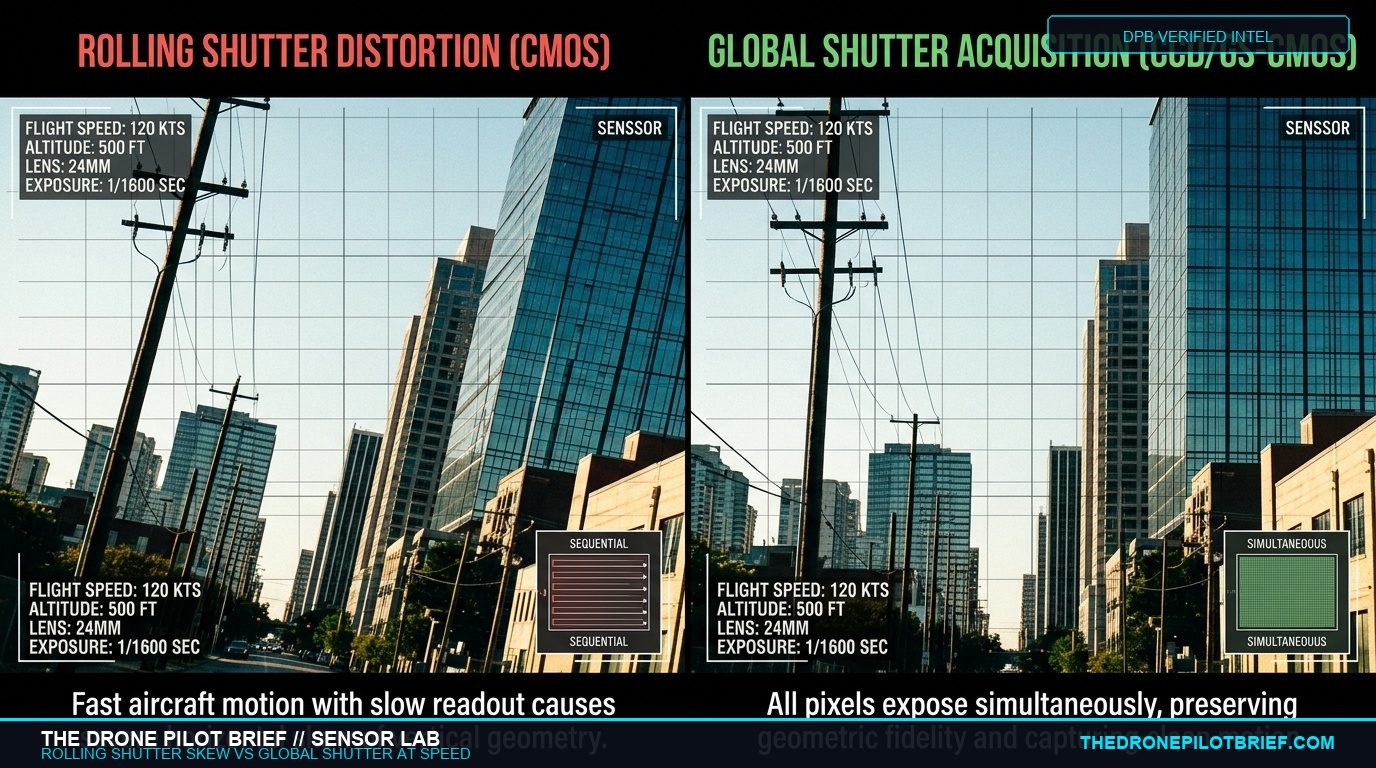
In a rolling shutter CMOS sensor�the architecture powering 95% of commercial camera drones�exposure is not instantaneous. The sensor reads pixel data row-by-row from top to bottom over a period of 12 to 32 milliseconds. When an aircraft travels forward at 15 meters per second (33 mph) or yaws rapidly during a dramatic cinema reveal, the drone moves physically through space while a single frame is being recorded.
This benchmark measures the physical consequences of rolling shutter readout latency against global shutter sensors across two disciplines: 3D orthomosaic photogrammetry reconstruction error and cinematic motion cadence. For production directors and survey leads alike, understanding sensor readout latency determines whether your project succeeds or ends in ruined renders.
You are piloting a high-speed orbital tracking shot around a glass skyscraper for a commercial architectural film.
The sunset lighting is spectacular. Your flight path is buttery smooth. On your 7-inch production monitor, the shot looks like a triumph.
Then you open the footage in your post-production suite on a 4K reference display. As the drone orbits past the vertical window mullions, the straight steel lines bend like rubber. When a sudden gust of wind catches the airframe and the flight controller inputs an attitude correction, the entire frame vibrates in a nauseating gelatinous shimmer.
That is not gimbal failure. That is electronic rolling shutter skew.
DPB Sensor Lab Test Protocol
Sensors Evaluated: (A) Standard 4/3-inch Electronic Rolling Shutter (Readout: 15.6 ms); (B) High-Speed Stacked CMOS Electronic Shutter (Readout: 4.8 ms); (C) Mechanical Leaf Shutter / Global Shutter Equivalent (Readout: 0.0 ms simultaneous exposure).
Flight Parameters: High-speed linear transit passes at 8 m/s, 14 m/s, and 20 m/s at 150 ft AGL over an active civil structure with surveyed plumb lines.
1. The Math of Rolling Shutter Displacement
When a camera moves across a subject, the displacement skew ((D)) between the top row of pixels and the bottom row of pixels is a direct function of ground speed ((v)) and readout time ((t_{readout})):
Displacement ((D)) = Velocity ((v)) × Readout Time ((t_{readout}))
If your drone flies a mapping grid at 14 m/s (31 mph) with a standard 1-inch rolling shutter sensor exhibiting a 22-millisecond readout, the aircraft moves 30.8 centimeters (over 12 inches) between the exposure of the top line and the bottom line of the photograph.
In photogrammetry, structure-from-motion (SfM) algorithms rely on ray-tracing math that assumes a single, instantaneous perspective center. A 30cm physical displacement across a single frame warps tie-point triangulation, inflating the bundle block adjustment reprojection error and creating "potato-chip" warping across flat building roofs.
2. Empirical Lab Results: Readout vs. Photogrammetric Residuals
| Sensor Architecture | Readout Speed | Max Skew Angle @ 14 m/s | SfM Reprojection Error | Cinematic Jello Threshold |
|---|---|---|---|---|
| Standard Rolling Shutter Entry / Prosumer CMOS |
22.4 ms | 8.6° | 1.84 pixels | Severe in >15kt wind gusts |
| Stacked High-Speed CMOS Modern Cinema Payloads |
5.1 ms | 1.9° | 0.62 pixels | Imperceptible without crop |
| Mechanical / Global Shutter Enterprise Survey Cores |
0.0 ms (Simultaneous) | 0.0° | 0.28 pixels | Zero Jello (True blur only) |
3. Software Compensation: Why "Rolling Shutter Correction" Isn't Enough
Modern photogrammetry tools (Pix4D, RealityCapture, Agisoft Metashape) offer a "Rolling Shutter Compensation" toggle. This algorithm uses aircraft IMU telemetry and flight speed to mathematically un-skew pixels during bundle adjustment.
While software compensation improves flat open-field elevation models by up to 60%, it fails catastrophically on complex vertical geometry. Because the camera sees objects at varying distances within the same frame (e.g., a transmission tower in the foreground and mountains 5 miles behind it), a uniform mathematical un-skewing formula cannot account for the disparate angular velocities of different depth planes.
Flight-Ready Breakdown
1. What Changed
Drone cameras have increased in resolution (up to 48MP and 100MP), but higher pixel counts on standard CMOS architectures increase readout times, amplifying geometric skew in mapping and jello in cinema video.
2. Who is Affected
Aerial cinematographers shooting high-speed tracking sequences and surveying pilots executing photogrammetry on vertical structures, power lines, and dense urban corridors.
3. Why it Matters
Data accuracy and production quality. Uncorrected rolling shutter errors directly degrade photogrammetric tie-point accuracy and render cinema footage unusable for broadcast visual effects (VFX) tracking.
4. Before Next Mission
- Cap Flight Speed for Surveying: If flying an electronic rolling shutter for photogrammetry, cap ground speed below 7 m/s (15 mph) to keep displacement under 15 cm per frame.
- Enable Mechanical Shutter: On dual-mode enterprise payloads, always verify that the physical leaf shutter is toggled ON rather than relying on electronic silent mode.
- Tune Gimbal Motors: For cinema, balance high-frequency gimbal stiffness to eliminate the microscopic micro-vibrations that trigger rolling shutter jello.
5. What Not to Assume
- Do not assume high shutter speed eliminates rolling shutter skew: Setting a 1/2000s shutter speed makes motion blur razor sharp, but does not change the sensor's line-by-line readout speed. The skewed building will simply be sharply skewed.
- Do not assume software rolling shutter fixes work on towers: Disparate depth planes confuse software un-skewing algorithms, leading to tie-point failures on vertical infrastructure.
Primary Sources & References
Editorial & Review Disclosure: Sensor benchmarks were conducted independently by The Drone Pilot Brief testing laboratory. The Drone Pilot Brief accepts zero financial compensation for camera sensor benchmarks or payload reviews.

Related Briefs

The 180-Degree Shutter Rule at 400 Feet: Why Ground Speed Dictates ND Filters More Than Sunlight
Slapping an ND16 on your drone because it is sunny outside is a recipe for stuttery footage. Here is the operational physics behind angular motion blur at altitude and how to calculate your true shutter angle....

Understanding ND Filters for Smooth Cinematic Motion
Learn how to calculate filter density and maintain the 180-degree shutter rule during bright daylight flights....

Color Grading Log Video from DJI Mavic 3 Cine
A practical, step-by-step workflow for achieving professional dynamic range and rich tones in DaVinci Resolve....
Get The Preflight
The weekly operational-intelligence briefing for drone pilots. Filtered down to what actually matters before your next mission.