The Brief
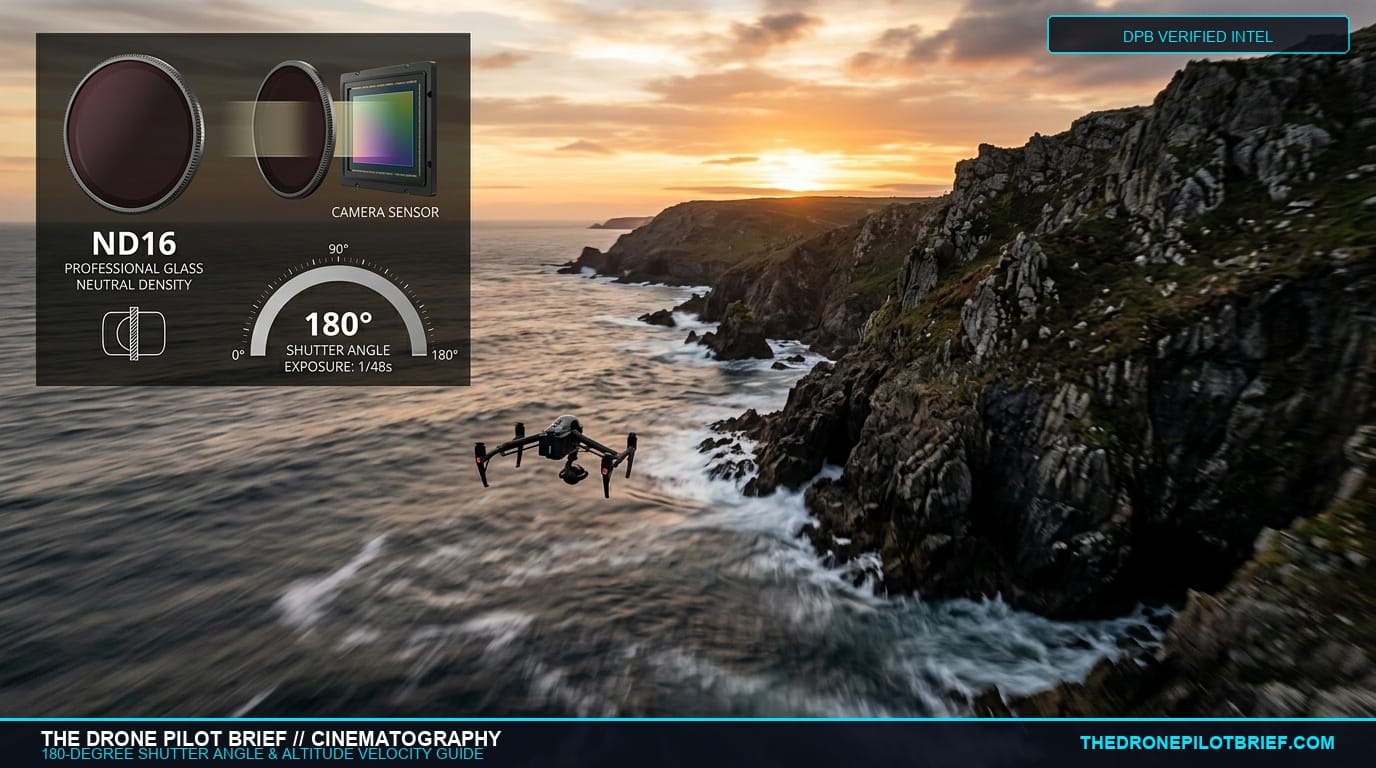
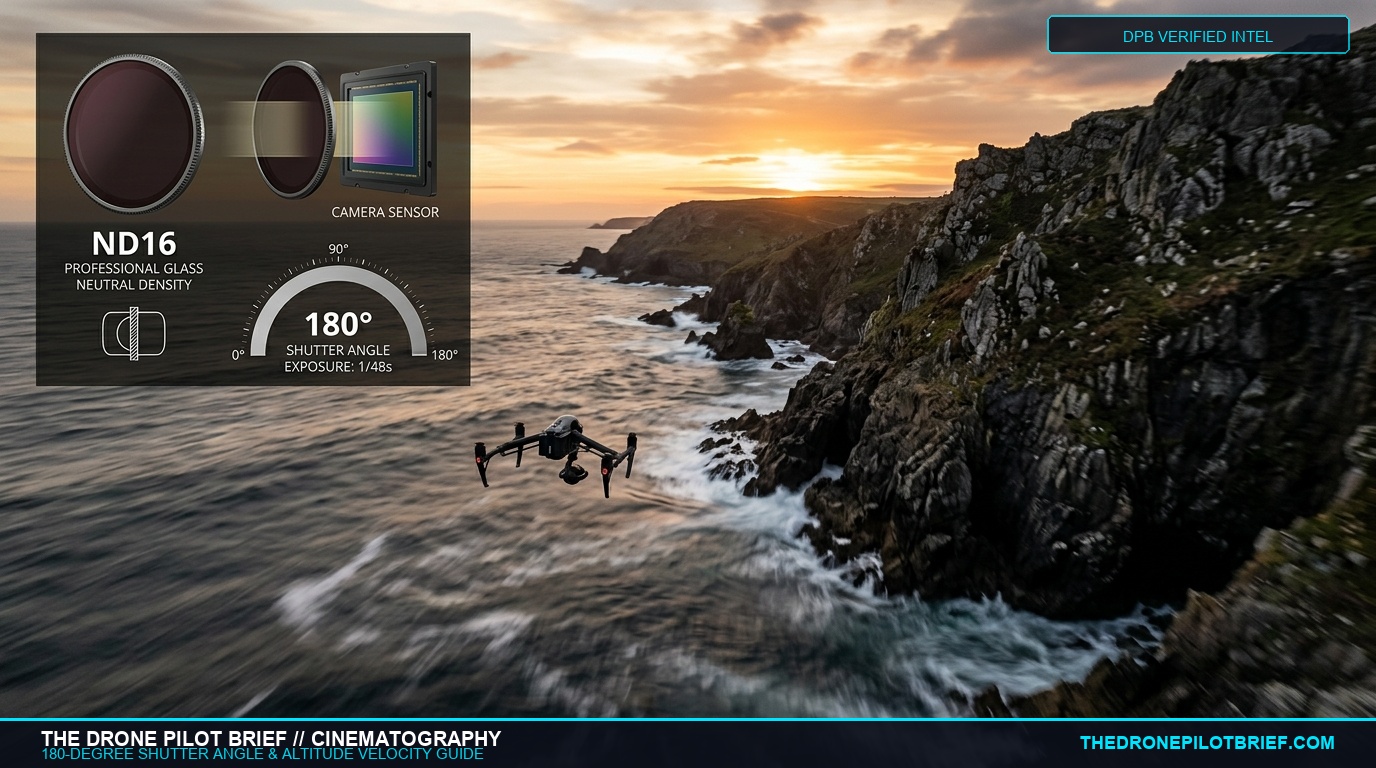
Every aspiring drone cinematographer memorizes the standard filmmaking rule: shoot at 24 frames per second, set your shutter speed to double your frame rate (1/50 or 1/48 of a second)�the venerable 180-degree shutter rule�and install neutral density (ND) filters to keep the exposure balanced in harsh sunlight.
Yet remote pilots routinely land their aircraft, inspect their footage on a desktop display, and wonder why their video looks completely wrong. High-altitude landscape reveals appear unnaturally smeared and soft, while low-altitude transit passes across trees stutter with choppy, optical friction.
The missing variable in aerial filmmaking is relative angular velocity across the focal plane. On the ground, camera motion is bounded by tripod pans or dolly tracks. In the air, your camera is traveling through a three-dimensional volume at 40 mph while observing objects hundreds of feet away. Understanding how altitude, forward ground speed, and focal length interact with shutter angle is what separates amateur drone video from Hollywood-grade aerial cinematography.
When you sit in a passenger jet cruising at 500 knots at 35,000 feet, look out the window at the patchwork fields below.
You are traveling at 80% the speed of sound, yet the ground appears almost completely motionless.
Now imagine skimming three feet above a desert highway in an open convertible at that exact same speed. The asphalt would be an instantaneous blur.
Speed in aerial filmmaking is an illusion governed entirely by altitude. And if your shutter angle does not account for altitude, your cinematic motion blur will fail.
The Angular Pixel Shift Equation
Motion blur is created when a subject's image shifts across physical sensor pixels while the shutter is open. The degree of blur is governed by Pixels Traversed per Exposure Time. At 400 feet, a drone moving forward at 15 m/s generates minimal angular shift in the background, but massive shift in the foreground.
1. The High-Altitude Trap: Why 1/50s Can Ruin 400-Foot Panoramas
When your drone is hovering or flying slowly at 350 to 400 feet AGL to capture a broad city skyline or mountain vista, the angular motion of distant terrain across your sensor is nearly zero.
If you force a 180-degree shutter (1/48s) using a heavy ND64 filter on a slightly breezy day, microscopic gimbal yaw oscillations and airframe buffeting will introduce rotational camera shake during that long 1/48s exposure window.
Because there is no fast-moving foreground to benefit from natural motion blur, the entire skyline simply looks soft and out of focus. In high-altitude, slow-transit establishing shots, breaking the 180-degree rule�increasing shutter speed to 1/120s or 1/240s�restores tack-sharp micro-contrast without introducing motion jitter.
2. The Low-Altitude Rule: Where the 180-Degree Rule is Non-Negotiable
Conversely, when flying low-altitude tracking passes�skimming 15 feet over waves, chasing a vehicle along a winding canyon, or tracking a runner through a forest�the foreground moves across your sensor at extreme angular velocity.
If you fly without ND filters in bright noon sunlight, the camera�s auto-exposure pushes shutter speed to 1/2000s or 1/4000s.
At 1/4000s, every blade of grass, pebble, and water droplet is frozen as an isolated, discrete frame. When played back at 24fps, the human eye cannot connect the frames smoothly, producing jarring, strobing "gladiator combat" motion jitter. Here, an ND32 or ND64 is mandatory to force the shutter back down to 1/48s, creating the natural optical motion blur our brains expect from cinema.
Flight-Ready Breakdown
1. What Changed
Remote pilots blindly apply the 180-degree shutter rule at all altitudes, failing to adjust for the drastic difference in angular pixel velocity between high-altitude panoramas and low-altitude proximity transit.
2. Who is Affected
Commercial drone filmmakers, real estate media creators, broadcast operators, and directors of photography utilizing prosumer and enterprise cinema UAS.
3. Why it Matters
Visual quality and client retention. Over-softened high-altitude landscape shots and strobing, stuttering low-altitude tracking shots are the telltale signatures of amateur drone video.
4. Before Next Mission
- Analyze Foreground Proximity: If your shot has foreground elements passing within 25 feet of the lens, strictly enforce the 180-degree shutter rule with ND filters.
- Break the Rule for High-Altitude Sweeps: At 300+ feet with no immediate foreground, allow shutter speeds of 1/120s to 1/240s to preserve edge acutance against wind buffeting.
- Use Circular Polarizers with Care: Avoid combining variable NDs or circular polarizers (CPL) on ultra-wide drone lenses, which produce uneven sky vignetting during yaw rotations.
5. What Not to Assume
- Do not assume ND filters "make video cinematic": ND filters only control exposure time; they do not improve dynamic range, color rendition, or composition.
- Do not assume auto-shutter is acceptable for commercial video: Shutter speed jumps mid-shot cause visible exposure stepping and sudden changes in motion cadence that cannot be corrected in post.
Primary Sources & References

Related Briefs
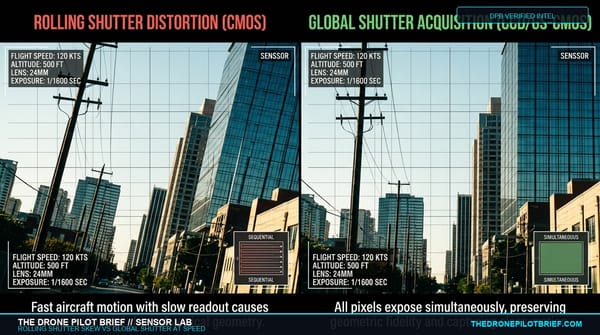
Rolling Shutter vs. Global Shutter at Speed: The Geometric & Cinematic Sensor Benchmark
Why do vertical telephone poles lean at 15 m/s and why does 4K cinema footage develop 'jello'? We bench-tested CMOS sensor readout speeds across aerial photogrammetry reconstructions and high-speed cinema passes....

Understanding ND Filters for Smooth Cinematic Motion
Learn how to calculate filter density and maintain the 180-degree shutter rule during bright daylight flights....

Color Grading Log Video from DJI Mavic 3 Cine
A practical, step-by-step workflow for achieving professional dynamic range and rich tones in DaVinci Resolve....
Get The Preflight
The weekly operational-intelligence briefing for drone pilots. Filtered down to what actually matters before your next mission.