
Operating a commercial drone business without liability insurance is an unacceptable business risk. However, many remote pilots learn the hard way that their standard commercial general liability (CGL) policies completely exclude aviation incidents.
To protect your company's assets, you must understand the distinction between on-demand coverage and annual aviation policies.
The Aviation Exclusion Pitfall
Most standard business insurance policies contain a boilerplate "aviation exclusion." This clause means that if your drone suffers a hardware failure and crashes into a luxury vehicle, a commercial window, or worse, injures a pedestrian, your insurer will immediately reject the claim. Commercial UAS operations require a dedicated aviation liability policy.
Dedicated drone insurance is split into two categories: **liability coverage** and **hull coverage**. Liability coverage protects you from third-party property damage and bodily injury claims (typically starting at a $1 million limit). Hull coverage covers physical damage to your aircraft. If you are flying a standard consumer drone, you may choose to skip hull coverage; however, if you operate a $20,000 LiDAR rig, hull insurance is essential to protect your capital investment.
Insurance Models Compared: On-Demand vs. Annual
Pilots have two primary models for securing insurance. The right choice depends on your weekly flight frequency and contract requirements:
| Insurance Model | Average Cost | Best Operating Profiles | Key Tradeoffs |
|---|---|---|---|
| On-Demand (Hourly/Daily) | $10 - $30 / hour | Part-time operators, weekend creative projects, spot inspections | Requires active app check-in; gets expensive with frequent flights |
| Annual Aviation Policy | $600 - $1,500 / year | Full-time operators, enterprise fleets, government contractors | Upfront premium cost; offers persistent coverage and commercial credibility |
Flight-Ready Breakdown
Business AuditWhat Changed
Aviation exclusions in standard business policies make dedicated aviation liability insurance mandatory for commercial Part 107 missions.
Why It Matters
A single property damage lawsuit can bankrupt a small drone business. Clients like construction managers require a certificate of insurance (COI) before site entry.
Before Your Next Mission
Audit your liability limits. Secure at least $1 million in aviation liability coverage, verify that your drone's serial number matches the policy certificate, and keep a PDF copy of the COI on your phone.
Securing Proof of Insurance
Large commercial clients and public agencies will require you to submit a Certificate of Insurance (COI) listing them as an "additional insured" before you can fly on their properties. Annual policies allow you to generate these certificates instantly via online portals at no additional charge, whereas on-demand systems may charge a minor premium adjustment. Choose the model that matches your volume to ensure you remain fully protected in the field.

Related Briefs

Moving from One-Off Job Bids to Recurring Retainers: The Annual Drone Inspection Agreement
Tired of the feast-or-famine cycle of one-off mapping gigs? Here is how to package multi-quarter asset monitoring retainers for solar, roofing, and construction clients that generate predictable monthly recurring revenue....
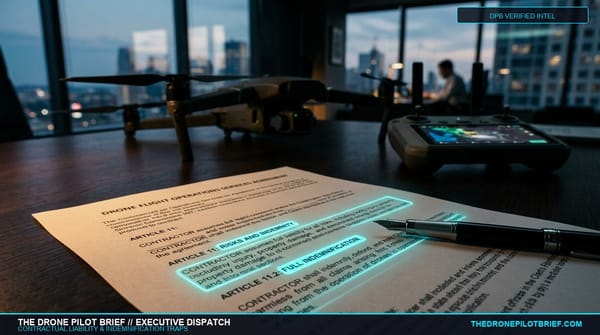
The Commercial Drone MSA: 5 Dangerous Contract Clauses That Shift Liability to Drone Operators
Before you sign an enterprise Master Services Agreement, read the fine print. Here is how prime contractors shift regulatory fines, site shutdowns, and equipment loss onto Part 107 pilots�and the exact redlines to protect your business....

Pricing Your Mapping Services: A Practical Guide
Calculate cost-of-goods-sold (COGS), airspace complexity risk, and volume margins for survey contracts....
Get The Preflight
The weekly operational-intelligence briefing for drone pilots. Filtered down to what actually matters before your next mission.