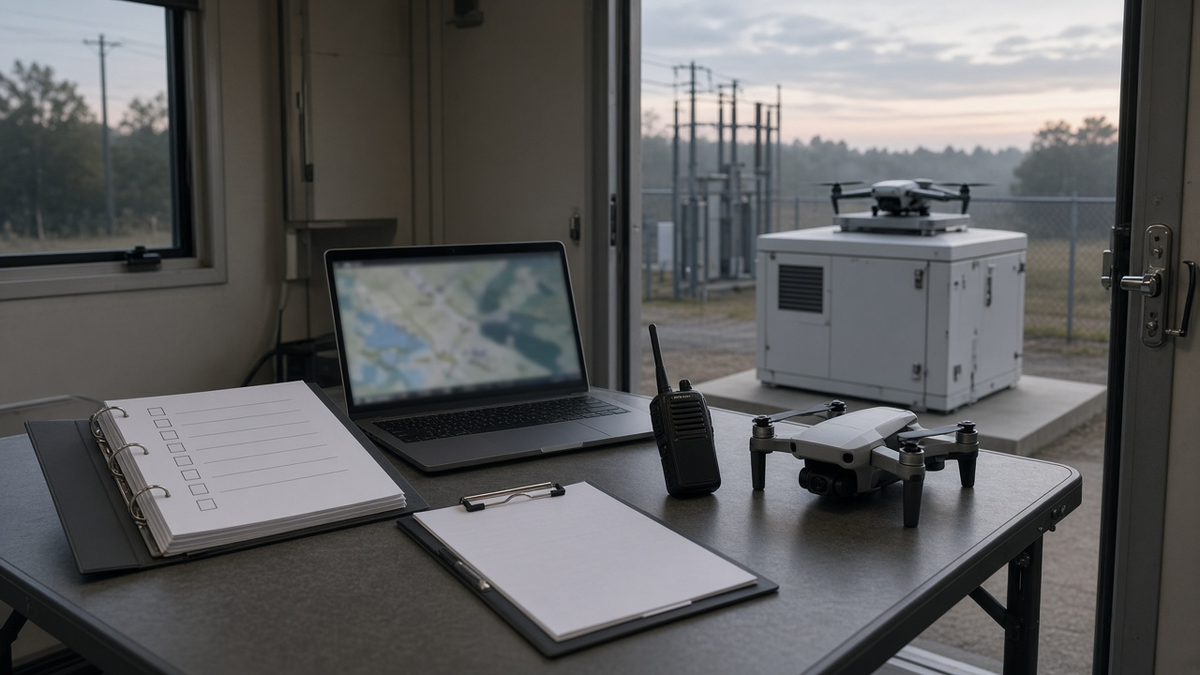
Say you run a three-person inspection crew. A pipeline company calls on a Monday. They want weekly flights along 12 miles of right-of-way, and they ask the question everyone asks now: "Once Part 108 comes out, can you fly it from a dock without anyone out there?"
The honest answer today is: not yet, and nobody outside the government knows exactly what the final rule says. But that doesn't mean the next few months are dead time. Most of what an operator would need under almost any version of a beyond-sight rule is work you can do now, under the rules you already fly by.
This is that list.
Key terms - Part 107: The FAA rule most commercial drone pilots fly under today (Title 14 of the Code of Federal Regulations, Part 107). It covers drones under 55 pounds. - Part 108: A proposed new FAA rule for flying drones beyond visual line of sight as a normal operation. It is not law. - BVLOS (beyond visual line of sight): Flying when neither the pilot nor an observer can see the drone with their own eyes. - FAA: Federal Aviation Administration, the U.S. agency that regulates aviation, including drones. - NPRM (notice of proposed rulemaking): The FAA's published draft of a rule. The public comments, then the agency writes a final rule. - OIRA: Office of Information and Regulatory Affairs, a White House office that reviews major rules before they're published. - Waiver: FAA permission to fly outside a specific Part 107 limit, under conditions the FAA sets. - SOP (standard operating procedure): Your written, step-by-step way of doing a job. - Lost link: When the radio connection between the controller and the drone drops. - Dock: A weatherproof box that stores, charges and launches a drone, often run remotely.
Where Part 108 actually stands
The FAA published its proposed rule, called "Normalizing Unmanned Aircraft Systems Beyond Visual Line of Sight Operations," in the Federal Register on Aug. 7, 2025. That was the NPRM, the draft. Public comments closed, were reopened briefly in early 2026, and closed again.
The FAA then sent a final rule to the White House. The government's regulatory tracking site, reginfo.gov, lists it as "Pending EO 12866 Regulatory Review," received July 10, 2026. EO 12866 is the executive order that sets up that White House review. As of Oct. 20, it is still listed as pending.
What that means for you: the final text isn't public. It may match the proposal, or it may not. Anything written today about "what Part 108 requires" is describing the proposal. That includes this article. If you want the backstory on how the industry got here, our history of the BVLOS rulemaking committee's proposals covers it.
What the proposal said (proposed, not final)
A few things from the August 2025 NPRM are worth knowing, because they shape what a reasonable prep list looks like. All of this is proposed:
- Two tiers. Operators would get either an operating permit (for lower-risk work) or an operating certificate (for more complex work, such as some package delivery). Certificates would require a safety management system.
- Bigger aircraft. The proposal covered drones up to 1,320 pounds, far above Part 107's 55-pound limit.
- New roles. It proposed an operations supervisor, a person with overall operational control for the company, and flight coordinators, people with hands-on oversight of flights in progress.
- Altitude. Operations would generally stay at or below 400 feet above ground level (AGL) unless the FAA authorized more.
- Records. It proposed keeping records of each flight for 24 months, and personnel and training records while someone works for you plus 12 months after they leave.
- Lost link. It called for appropriate lost-link procedures and treated loss of the control link as a key risk.
The final rule could change any of these. The useful takeaway is the pattern: written procedures, named roles, records, and a plan for when the link drops. You can build all four now.
The checklist
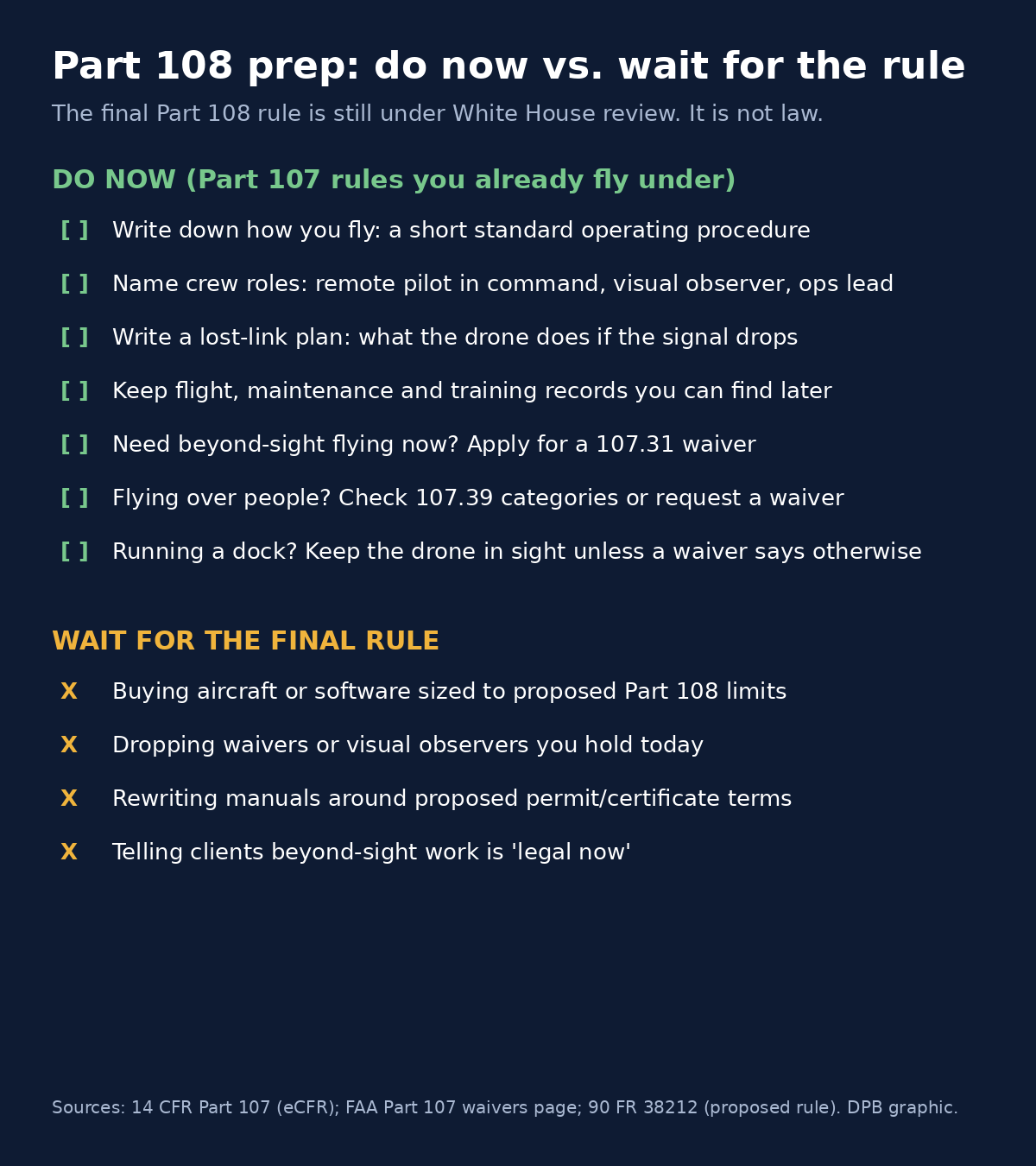
1. Write down how you fly
Most small crews carry their procedures in their heads. Put them on paper: preflight, site survey, weather limits, airspace check, launch, in-flight calls, landing, postflight. Keep it short enough that people actually read it. Part 107 already requires a preflight check of the operating area and the aircraft (14 CFR 107.15 and 107.49). A written SOP is how you show you do it the same way every time.
2. Name the crew roles
Under Part 107, there's a remote pilot in command (the certificated person responsible for the flight) and, if you use one, a visual observer (a person who watches the drone and the sky for the pilot). Write down who fills each role on each job, and who on your team makes the go or no-go call for the company. The proposal's operations supervisor and flight coordinator roles map loosely onto those jobs. You don't need the new titles. You need clear answers to "who's in charge of this flight?" and "who's in charge of the operation?"
3. Write a lost-link plan
Every crew should be able to answer: if the link drops, what does the drone do, and what do we do? Write down your return-to-home altitude for each site, what obstacles are on the way home, who calls whom, and when you'd notify anyone else. Test the setting before each job, not after.
4. Keep records you can find
Logbooks, maintenance notes, battery cycles, training, incidents. Pick one system and use it on every flight. The proposal leaned hard on records, and clients and insurers already ask for them. If you can't pull last spring's flight log in five minutes, fix that first.
5. Use the waiver path that exists today
You don't have to wait for Part 108 to fly beyond sight. Part 107 lets the FAA waive specific rules (14 CFR 107.205), including:
- 107.31, visual line of sight: the rule that the pilot or observer must be able to see the drone with their own eyes. A waiver can allow beyond-sight flying. Under 107.205, it can't be used to carry someone else's property for pay.
- 107.39, flying over people: if your drone doesn't fit one of the existing over-people categories.
- 107.33, visual observer rules and 107.35, flying more than one drone per pilot.
The FAA's waiver page says new Part 107 waiver applications now go through its Aviation Safety Hub, which replaced FAADroneZone for new waiver applications. (Airspace authorizations still go through FAADroneZone.) The FAA asks you to describe the operation, the risks, and how you'll reduce them. The SOP, roles, lost-link plan and records from steps 1 through 4 are exactly that material.
6. Answer the dock question honestly
Can you fly a dock under Part 107 today? A dock is equipment, and Part 107 doesn't ban it. But the same rules still apply. A remote pilot in command must be responsible for every flight. Under 107.31, the pilot or a visual observer must be able to see the drone throughout the flight unless you hold a waiver that says otherwise. Our reading of 107.31 and 107.205: a dock on a roof with the drone flying out of sight, and nobody watching, needs a waiver for that operation. Check the exact conditions of any waiver you hold before you tell a client yes.
7. Don't spend ahead of the rule
Hold off on buying aircraft or software sized to the proposal's limits, dropping observers or waivers you rely on today, or telling clients that beyond-sight work "is legal now." Wait for the published final rule and its effective date.
What this doesn't change
Today you fly under Part 107, plus whatever waiver or authorization you actually hold. Part 108 changes nothing until a final rule is published and takes effect. When it does, we'll read the final text and update this list.

Related Briefs
Why Your Drone Can’t Legally Fly on 5G (And How 200 Aircraft Just Cracked the Wall)
The FCC granted a temporary nationwide waiver for DOT’s Mobile Network Aviation Assessment Program. It bypasses decades of cellular airborne restrictions across 14 spectrum bands — but Part 107 pilots cannot fly on it yet....

TSA Wants Industry Voices for Future BVLOS Security Programs — RSVP by October 19
TSA is soliciting operators and associations for closed technical roundtables that will help shape model language for TSA-approved UAS BVLOS security programs. Requests were due October 19, 2026, and that window has closed; TSA may open a new registration period after its final rule publishes. This notice is not a final rule and does not authorize BVLOS flight....

Part 108 BVLOS Rule Advances to OIRA Review: What It Means Today
The draft Part 108 BVLOS final rule is under OIRA review under RIN 2120-AL82. It is not currently operative law. Part 107 still governs ordinary commercial small-UAS work, plus whatever waiver you actually hold. Part 135 carriers stay on that certificate until a published Part 108 rule actually applies to them....
Get The Preflight
The weekly operational-intelligence briefing for drone pilots. Filtered down to what actually matters before your next mission.