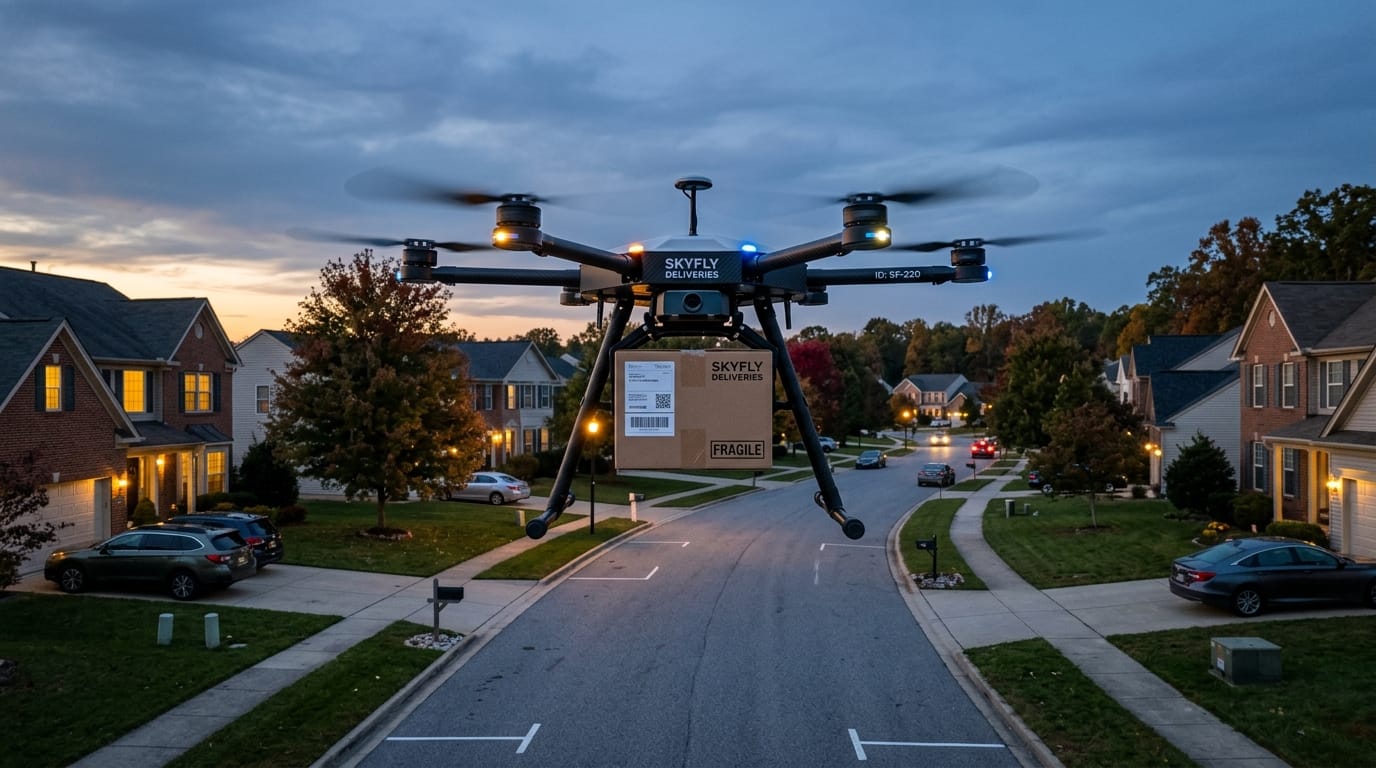
Amazon’s year-end “nearly 500 communities” figure is a company expansion target from its 19 August 2026 announcement. It is not an FAA authorization for other operators, not a transfer of Prime Air Operations Specifications onto a Part 107 remote pilot certificate, and not proof that Part 108 is live. Part 108 remains under executive interagency review at OIRA under RIN 2120-AL82 (RegInfo rrid=1457213) and is not operative law. Commercial package delivery by drone scales today under Part 135 air carrier certificates and case-specific approvals — not under someone else’s press release.
The Brief
The client has the tablet open to the statement of work. You are walking the property line for a roof-and-facade mapping job — Part 107, VLOS, LAANC already filed for the grid. Then the phone lights up with a link: Amazon says nearly 500 communities by the end of 2026. The client does not ask about OpSpecs. They ask the driveway question every delivery-heavy suburb invents: “If Amazon can do five hundred towns, why are we still stuck with a visual observer and a waiver queue?”
That mash-up is the story. Not the logo on the belly of the aircraft that may already be in the same low-altitude band. The rule the headline invents in a Part 107 pilot’s head.
You feel the pressure in three beats: the number sounds like nationwide permission; nationwide permission feels like precedent; precedent feels like your next mission can leave visual line of sight because a logistics brand got louder. None of those beats is a certificate. The client is not being unreasonable. They are reading the same company announcement you are. Your job is to keep the conversation on the paper you hold — remote pilot certificate, any waiver you actually have, LAANC where it applies — not on Amazon’s year-end plan.
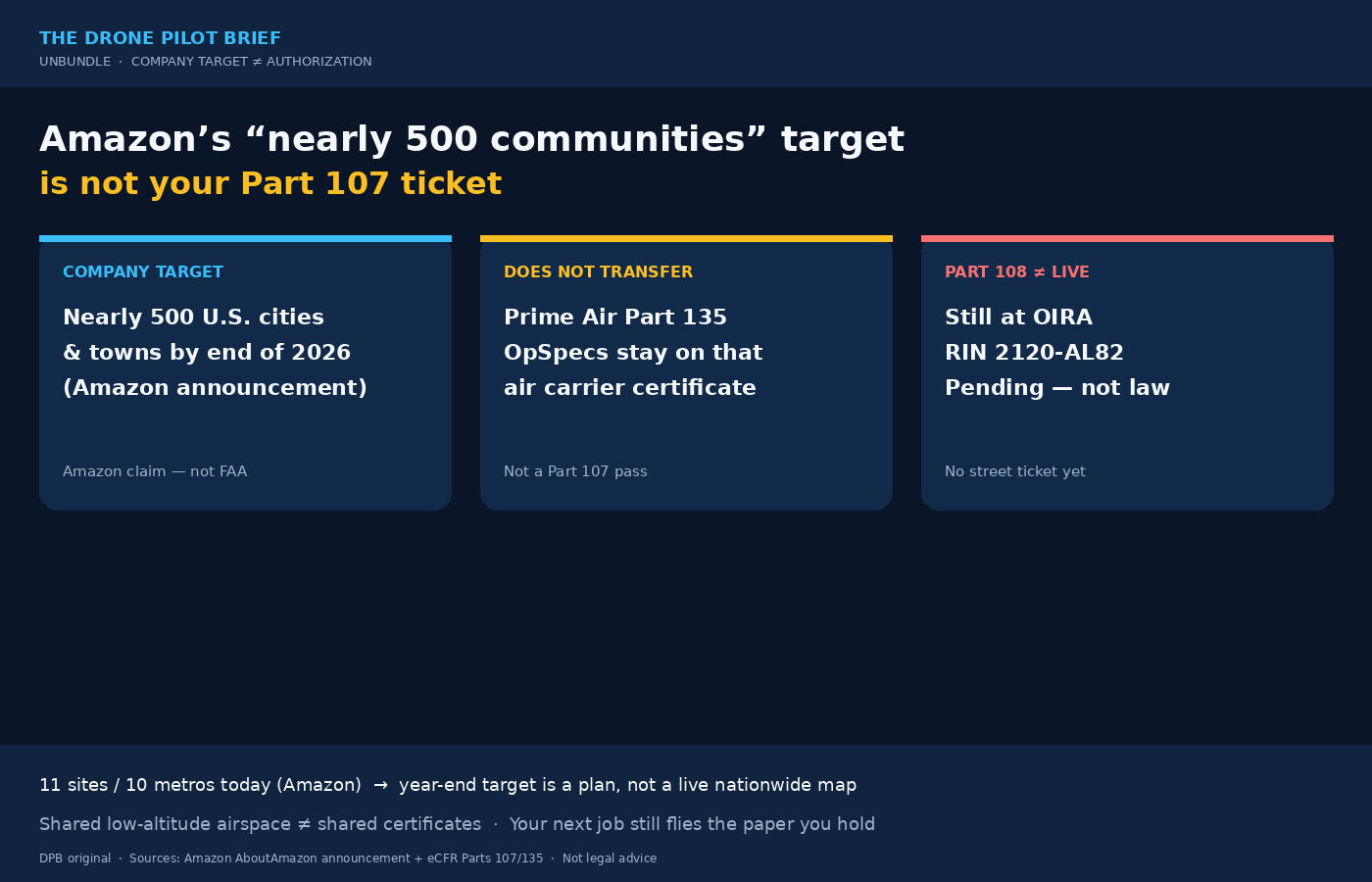
Amazon’s own announcement (19 August 2026) says Prime Air plans to reach nearly 500 U.S. cities and towns by the end of 2026 — a sixfold increase from its current footprint — and currently serves customers from 11 U.S. sites across 10 metro areas. Amazon states Prime Air holds FAA Part 135 certification. Those are company claims. They are not your OpSpecs, not a Part 107 BVLOS blueprint, and not Part 108.
The rest of this piece earns that unbundle: what Amazon actually said, whose certificate carries the expansion, why OpSpecs geography does not transfer, what Part 107 crews still do in delivery-heavy suburbs, and what remains uncertain.
“Nearly 500” is Amazon’s year-end target — not a live nationwide map
Amazon’s announcement is specific about the claim and the baseline. The company says it plans to reach nearly 500 U.S. cities and towns by the end of 2026 — a sixfold increase from its current footprint. It says Prime Air currently offers drone delivery from 11 U.S. locations across 10 metro areas, with each site serving an area of approximately 175 square miles. It names current sites: Tolleson, AZ; Ruskin, FL; Kansas City, KS; Papillion, NE; Baton Rouge, LA; Hazel Park and Pontiac, MI; Richmond, San Antonio, Richardson, and Waco, TX. It says additional metros are coming soon: Chicago, Syracuse, Cleveland, Atlanta, and Boise. It also says it launched Prime Air in Darlington, England.
Read that stack for what it is. A company plan from a stated 11-site network toward a year-end community target. It is not a federal map of 500 already-authorized towns. It is not an FAA press release. It is not a Part 107 open-skies order. The sixfold language is Amazon’s comparison to its own current footprint — useful for understanding the scale of the plan, useless as a count of towns already receiving packages today.
For the Part 107 crew, the skim mistake is the same every time a big number lands in a client’s inbox: the number becomes a map, the map becomes a rule, and the rule becomes “why can’t we.” Stop the chain at the primary. Amazon said nearly 500 by year-end. Amazon said 11 sites now. Everything between those two sentences is execution under their certificate — not a transfer of authority to the mapping crew on the driveway.
Fact: Amazon’s primary states a nearly-500-by-end-2026 target and a current 11-site / 10-metro U.S. footprint.
Interpretation: Treating the target as already-live nationwide service invents geography the announcement does not claim.
Prime Air’s path is Part 135 — not your Part 107 ticket
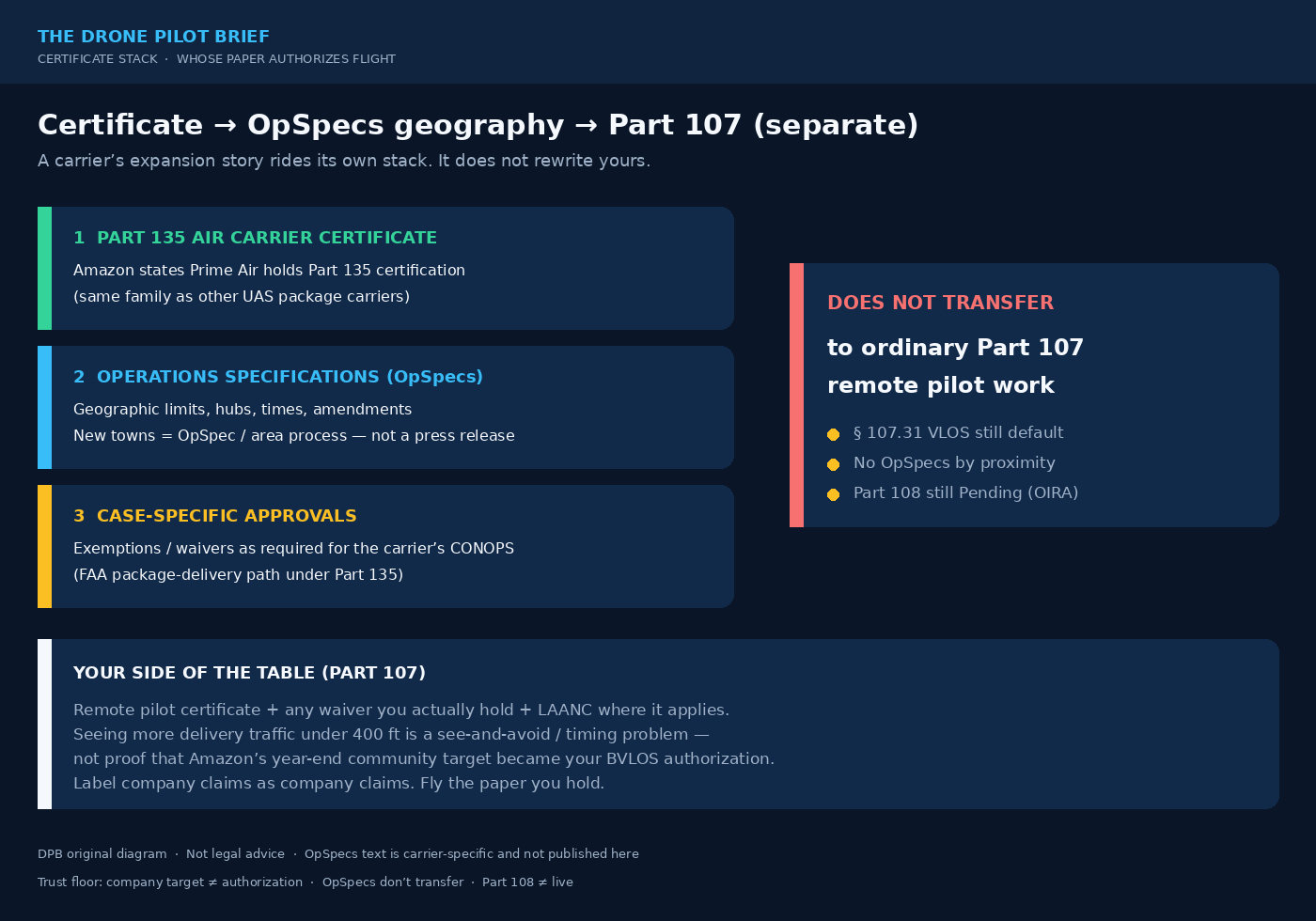
Amazon states that Prime Air holds FAA Part 135 certification — the air carrier framework used for commercial package delivery by drone under today’s FAA path. That matters for accuracy. It also matters for the driveway mash-up.
Compensated BVLOS package delivery — carrying the property of another for hire beyond visual line of sight — runs today through Part 135 (with related certificate architecture and Operations Specifications), not through a Part 107 remote pilot certificate with a louder motor. FAA’s package-delivery materials describe that door for operators that want small package delivery: the existing Part 135 certification process plus the exemptions or waivers required for BVLOS delivery. Ordinary Part 107 commercial work stays under 14 CFR Part 107. Visual line of sight under § 107.31 remains the default unless an individual waiver says otherwise. A visual observer under § 107.33 remains a Part 107 tool when you use one. Right-of-way under § 107.37 does not rewrite itself because a logistics brand published a community count.
When the client points at the “nearly 500” headline and asks whether autonomy is open, translate the question. They are asking whether your next mission can leave VLOS. The answer still starts with your certificate and your paperwork — not with Amazon’s certificate family.
Fact: Amazon cites Part 135 for Prime Air; Part 107 remains the operative rule set for most DPB readers’ commercial jobs.
Interpretation: Different rule part, different certificate, different showing to FAA.
OpSpecs stay on that carrier’s certificate — geography included
Expansion headlines for delivery networks are usually Operations Specifications and area-amendment stories. When a Part 135 certificate holder changes scope — new hubs, new delivery areas, modified times — the operative federal action is typically an OpSpec amendment for a defined operating area, not a blank check from the certificate alone and not a public corridor opened by marketing copy. FAA’s package-delivery materials put the scaling path on that certificate-holder architecture: Part 135 process plus the case-specific exemptions or waivers the carrier’s concept of operations requires. A press release that lists metros is not a substitute for that paper.
Amazon’s announcement names sites and metros and describes each site’s approximate service area — about 175 square miles per site, per Amazon. That geography rides with Prime Air’s approvals. An independent Part 107 operator on an enterprise mapping job has no legal claim to those OpSpecs. Citing a competitor’s Part 135 delivery network is not a substitute for your own waiver or exemption. The coming-soon list (Chicago, Syracuse, Cleveland, Atlanta, Boise) is still Amazon’s launch plan language. Until a given metro is actually served under that carrier’s authorizations, treat “coming soon” as company schedule — not as proof the town is already inside live OpSpecs, and never as proof your job inherited anything.
Sharing suburban low-altitude airspace with delivery traffic is ordinary now in more metros. Part 107 commercial work and Part 135 delivery traffic both live in low-altitude volumes — often under 400 feet AGL in the same suburbs. You share the sky whether you asked for the neighbor’s delivery network or not. Sharing airspace is not sharing certificates. Deconfliction on a Part 107 job still starts with eyes, observers where used, and the authorizations on your paperwork.
The practical sting for Part 107 crews: more small, fast, outbound-and-return traffic under about 400 feet AGL in places LAANC already constrains. That is a see-and-avoid and mission-timing problem. It is not a shielded corridor, a right-of-way change, a Remote ID holiday, or a reason to “match their profile.” You are not on their OpSpecs.
Fact: OpSpecs and operating areas attach to the certificate holder that holds them.
Interpretation: Proximity to Prime Air traffic is not permission to fly Prime Air’s profile.
MK30, five-pound shoeboxes, and “as fast as 30 minutes” are company claims
Amazon describes the MK30 as delivering double the range and half the noise of any previous Amazon delivery drone. It says nearly all items about 5 pounds or less that fit a large shoebox can be delivered by drone, in as fast as 30 minutes, with most orders around 60 minutes after checkout. It describes onboard detect-and-avoid as enabling the aircraft to monitor airspace and make real-time safety decisions.
Those are manufacturer/operator claims from Amazon’s announcement. DPB did not flight-test the MK30. Do not treat MK30 range, noise, or detect-and-avoid language as performance numbers for a Part 107 Mavic-class aircraft on a mapping job. Do not treat Amazon’s detect-and-avoid description as a public sense-and-avoid standard that rewrites § 107.31 for everyone else. Their system runs under their certificate and approvals.
Fact: Double-range / half-noise / ~5 lb shoebox / as-fast-as-30-min language comes from Amazon’s primary.
Interpretation: Company product claims are not your aircraft’s performance card and not your waiver.
Part 108 is still at OIRA — the 500-town headline does not finish it
Part 108 (RIN 2120-AL82) is the FAA’s draft effort to normalize many BVLOS operations, including a longer-term home for package delivery after a final rule and implementation prerequisites. The draft final rule remains in Pending EO 12866 Regulatory Review on RegInfo record rrid=1457213. Pending review does not create standardized Part 108 corridors. It does not wipe Part 107 visual-line-of-sight defaults. It does not launder a carrier’s approvals onto everyone else.
A company target of nearly 500 communities by year-end can be true as a logistics plan and still say nothing about whether Part 108 has become law. Delivery growth under Part 135 proves Part 135 authorizations are being used. It does not prove Part 108 finished.
Fact: Part 108 is not operative law while it sits at OIRA under RIN 2120-AL82.
Interpretation: Do not answer the driveway question with “Part 108 must be open — look at Amazon.”
What a Part 107 crew still does when the client quotes “500 towns”
Keep the visual scan honest in delivery-heavy suburbs. Deconflict against automated transit paths you have actually seen. Keep LAANC current where it applies. Brief observers on silhouette, sound, and typical transit height so a surprise Prime Air–class transit does not become a mid-mission argument on the radio. Do not rewrite right-of-way under § 107.37 because a press release got louder.
If the client asks whether Amazon’s expansion means the visual observer can go home: answer from your certificate and your waiver — not from the year-end community target. Practical texture for the driveway conversation:
- Name the certificate on the table: Part 107 remote pilot (plus any waiver you hold), not Part 135 OpSpecs.
- Separate “Amazon plans nearly 500 communities” from “I am authorized to leave VLOS on this job.”
- Separate “I may see more delivery traffic under 400 feet” from “I can match their profile.”
- If the client wants BVLOS for this job, the path is their own CONOPS, risk showing, and waiver/exemption process — not a screenshot of an AboutAmazon page.
- Before the next mission in a listed or coming-soon metro: refresh NOTAMs and LAANC, brief the observer on transit patterns, and write the go/no-go in language that survives a phone call with insurance or the FSDO.
None of that is legal advice. It is the difference between flying the certificate you hold and flying the story a company headline invents.
Flight-Ready — pull this into the mission brief
Amazon’s nearly-500-communities figure is a company year-end target from a stated 11-site / 10-metro U.S. network — not an FAA authorization for other operators. Prime Air’s path is Part 135 with OpSpecs geography; those OpSpecs do not transfer to ordinary Part 107 work. Part 108 remains Pending at OIRA (RIN 2120-AL82). More delivery volume under 400 feet is a see-and-avoid and timing problem. It is not a corridor, a right-of-way change, or a RID holiday. MK30 and delivery-speed claims are Amazon’s; DPB did not flight-test them. Do not match their profile. Fly the paper you hold.
Bottom Line
“Nearly 500 communities by the end of 2026” is Amazon’s expansion target, not an FAA green light for anyone else. Prime Air flies under Part 135; OpSpecs stay on that certificate. Part 108 is still at OIRA. For ordinary Part 107 commercial work, visual line-of-sight stays the default unless your own waiver says otherwise — and a logistics headline never becomes that waiver by proximity.
amazon-prime-air-narrative-2026-09-18-v1 replaces the Flight-Ready Breakdown template with site-story narrative (driveway mash-up scene, claim-style H2s, mid-article teaching visuals, fuller Part 135 / OpSpecs / Part 108 unbundle) while keeping the trust floor, Amazon primary claims, and the 3 September MK30 / Part 135 correction. Live site = story; The Preflight stays brief/literal.
Sources
- • Amazon — Prime Air expansion announcement: https://www.aboutamazon.com/news/transportation/amazon-prime-air-drone-delivery-expansion
- • 14 CFR Part 107: https://www.ecfr.gov/current/title-14/chapter-I/subchapter-F/part-107
- • 14 CFR Part 135: https://www.ecfr.gov/current/title-14/chapter-I/subchapter-G/part-135
- • FAA Package Delivery by Drone (Part 135): https://www.faa.gov/uas/advanced_operations/package_delivery_drone
- • OIRA RIN 2120-AL82: https://www.reginfo.gov/public/do/eoDetails?rrid=1457213
The Drone Pilot Brief does not accept payment for editorial coverage. Amazon was not interviewed for this update.

Related Briefs

The Digital Tollbooth: Inside Proposed Part 146 and the Corporate Battle to Control Low-Altitude Airspace
While the drone industry watches Part 108, the real business model is quietly unfolding in proposed Part 146. Here is how Automated Data Service Providers will gate, monitor, and monetize low-altitude commercial flight....

California’s 400-Foot Stadium Drone Bill Reaches the Governor: What It Means for Event Airspace
California lawmakers passed AB 2113, establishing a $500 fine for flying within 400 feet of outdoor concerts and sporting events. With Governor Newsom facing a September 30 deadline, the bill reignites the legal battle over federal airspace preemption....

Gravity for U.S. Military Drone Operator Assessment
USNDA and OUSW(R&E) establish National Drone Wars as the central venue for evaluating U.S. military drone operator proficiency, signaling a major shift in UAS modernization, procurement, and doctrine....
Get The Preflight
The weekly operational-intelligence briefing for drone pilots. Filtered down to what actually matters before your next mission.