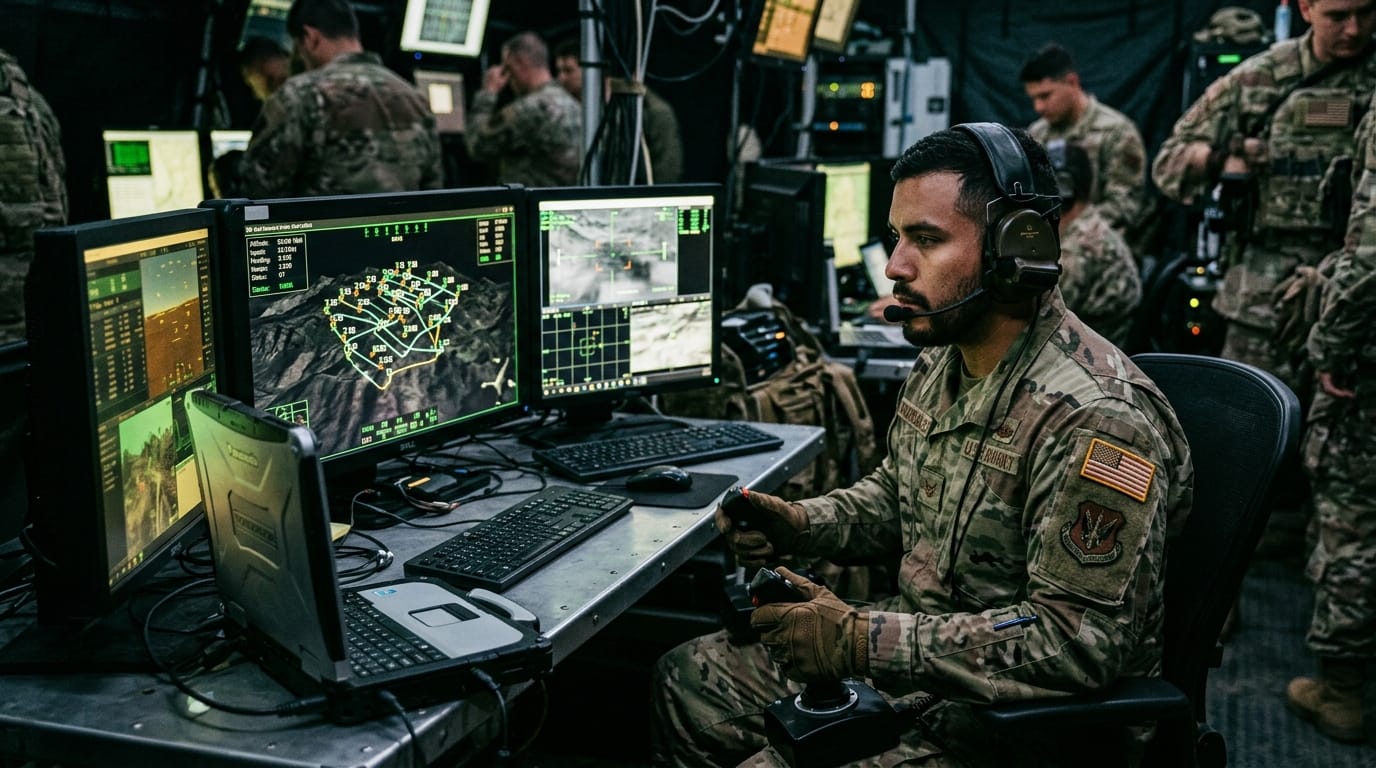
The United States National Drone Association (USNDA), in coordination with the Office of the Under Secretary of War for Research & Engineering (OUSW R&E), has designated Top Drone National Drone Wars as the primary national venue for evaluating U.S. military drone operator proficiency.
This transition marks a structural modernization in how the Department of Defense identifies, measures, and accelerates operator talent — with implications for readiness, procurement, and future UAS doctrine.
Program Snapshot
A DPB-style sidebar summarizing the program’s core attributes.
- Lead Organizations: USNDA + OUSW(R&E)
- Primary Function: National operator assessment venue
- Focus Areas: Precision control, tactical decision-making, swarm coordination, attack-UAS employment
- Feeder Programs: Drone Dominance, Swarm Forge, DRPM UAS
- Qualification Opens: October 2026
- Interservice Events: Q1 2027
- Participants: All service branches + approved experimentation teams
Historical Context: Two Decades of U.S. Drone Operator Evolution
Large-platform UAS (Predator, Reaper) — structured, hierarchical, platform-specific.
Small-to-medium attack drones became central to contested-environment operations.
Operator skill — not platform size — became the decisive variable.
“The U.S. drone ecosystem outgrew its evaluation model. National Drone Wars is the modernization response.”
Modernization Lineage: Why National Drone Wars Fits the Current DoD Trajectory
Distributed Operations
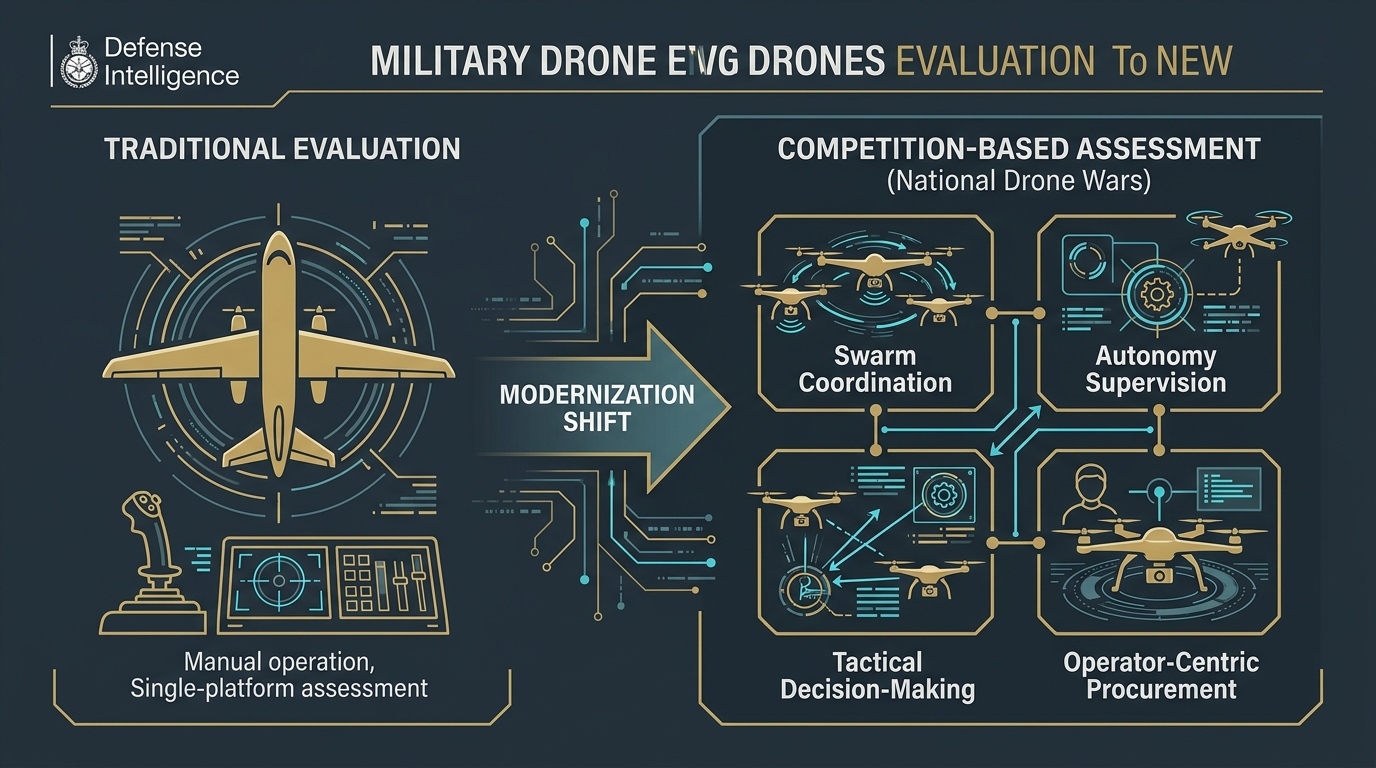
Future conflict requires operators who can manage autonomous systems across dispersed environments.
Autonomy Supervision
Operators must oversee decision-support systems, not just manually pilot drones.
Swarm Coordination
Swarm Forge and related programs demand multi-vehicle control skills that traditional pipelines do not address.
Attack-UAS Integration
Small-to-medium attack drones require precision, tactical decision-making, and rapid adaptation — skills best measured under competitive pressure.
Operator-Centric Procurement
DoD increasingly evaluates platforms based on how well operators perform with them.
Assessment Framework: How National Drone Wars Measures Talent
Core Evaluation Components
- Precision flight and control
- Scenario-based tactical decision-making
- Documentation and safety compliance
- Platform-specific technical proficiency
- Multi-vehicle coordination (Swarm Forge)
- Attack-UAS mission execution (Drone Dominance)
Timeline
- Qualification opens October 2026
- Interservice events begin Q1 2027
Participants
- Army
- Air Force
- Navy
- Marine Corps
- Space Force
- Approved DoD experimentation teams
Data Outputs
- Operator performance metrics
- Platform reliability indicators
- Mission-scenario outcomes
- Training pipeline insights
- Procurement-relevant capability data
“Competition-based assessment is becoming a preferred DoD model for accelerating capability maturation.”
KOE Analysis: The Deeper Meaning Behind the Transition
Key Observation
Operator proficiency is now a strategic differentiator in modern conflict.
Opportunity
Create a national scoreboard for drone operator readiness — one that aligns training, procurement, and experimentation.
Execution
A repeatable, defensible, interservice competition model that produces measurable operator performance data.
Strategic Signal Framework: What This Announcement Really Signals
1. Signal — Operator Talent Is Now Core Warfighting Capability
Drone operators are central to distributed operations, autonomy supervision, and attack-UAS employment.
2. Proof — The Programs Feeding Into the Competition
- Drone Dominance
- Swarm Forge
- DRPM UAS
These programs demonstrate sustained investment in operator skill, swarm coordination, and attack-UAS integration.
3. Relevance — Why Leaders Should Care
Operator performance will increasingly shape:
- Procurement decisions
- Training investments
- Operational doctrine
- Technology development priorities
This is not theoretical.
It is operational, immediate, and measurable.
Procurement Implications: Capability Will Be Measured Through Operator Performance
DPB has tracked a growing trend: Operator-centric procurement.
National Drone Wars accelerates it.
Platforms that enable:
- Higher operator precision
- Better decision-making
- More reliable mission execution
- More effective swarm coordination
…will gain procurement advantage.
Stakeholder Impact: Who This Affects and How
For DoD Leadership
National Drone Wars becomes a readiness instrument, not just a competition.
For Service UAS Communities
Expect convergence in training standards, evaluation criteria, and mission-scenario design.
For Industry
Procurement will shift toward platforms that perform well under competitive conditions — not just those that perform well in demonstrations.
For Policymakers
Competition data will provide a clearer picture of modernization progress and operator readiness.
Doctrine Trajectory: Where This Fits in Future U.S. UAS Doctrine
- Operator-Driven Doctrine Development: Expect doctrine to evolve around operator performance data, not platform specifications.
- Interservice Standardization: Shared assessment → shared standards → shared doctrine.
- Integration with Autonomy & EW: Operator evaluation will merge with autonomy supervision and electronic warfare mission sets.
- Data-Driven Readiness Models: Competition outputs will feed into readiness scoring, training cycles, and modernization planning.
“Operator performance is becoming a doctrinal input, not just a training outcome.”
What to Watch: Indicators of How This Will Evolve
- Interservice Doctrine Convergence: Shared assessment → shared standards → shared doctrine.
- Expansion of Competition-Based Assessment: Expect similar models for EW operators, autonomy supervisors, and distributed-operations teams.
- Procurement Shifts: Watch for RFPs referencing competition performance data.
- Training Pipeline Redesign: Services will restructure UAS training around competition-validated skill sets.
- Industry Alignment: Manufacturers will begin optimizing platforms for operator performance metrics.
Flight-Ready Breakdown
Defense DoctrineWhat Changed
USNDA and OUSW(R&E) designated Top Drone National Drone Wars as the primary national venue for evaluating U.S. military drone operator proficiency across all services.
Who is Affected
Service branch UAS operators (Army, Air Force, Navy, Marine Corps, Space Force), defense hardware program offices, and industry contractors.
Why it Matters
Shifts the readiness model from platform-centric specs to empirical operator performance, directly driving procurement decisions and interservice doctrine.
Before Next Mission
Military flight leads preparing for the October 2026 qualification window must benchmark multi-vehicle swarm control and dynamic EW threat assessment.
What Not to Assume
Do not assume this is a civilian hobby tournament. Do not assume single-platform manual proficiency translates to swarm coordination. Do not assume traditional training pipelines satisfy these criteria.
Bottom Line
Top Drone National Drone Wars is more than a competition.
It is the new center of gravity for U.S. drone operator assessment — a structural modernization of how the U.S. cultivates, measures, and accelerates UAS capability.
Through the lens of historical context, modernization lineage, KOE, and the Strategic Signal Framework, the transition represents:
- A recognition of operator talent as a strategic asset
- A consolidation of fragmented assessment pipelines
- A modernization of readiness measurement
- A new mechanism for aligning training, procurement, and experimentation
This is the beginning of a new era in U.S. drone operations — one where operator skill is measurable, comparable, and strategically decisive.
Sources
- • U.S. National Drone Association (USNDA): Official Announcement: Transition of Top Drone Program and National Drone Wars Venue (16 September 2026) — https://www.usnda.org/
- • Office of the Under Secretary of War for Research and Engineering (OUSW(R&E)): Defense Innovation & Drone Dominance Program Directives — https://www.war.gov/Spotlights/Drone-Dominance/
- • Executive Order 14307: Unleashing American Drone Dominance, Implementation Framework — https://www.federalregister.gov/
Editor’s Note: This feature is part of DPB’s ongoing coverage of U.S. defense modernization, autonomy integration, and emerging operator-centric capability pipelines. The Drone Pilot Brief does not accept payment for editorial coverage.

Related Briefs

The Digital Tollbooth: Inside Proposed Part 146 and the Corporate Battle to Control Low-Altitude Airspace
While the drone industry watches Part 108, the real business model is quietly unfolding in proposed Part 146. Here is how Automated Data Service Providers will gate, monitor, and monetize low-altitude commercial flight....

California’s 400-Foot Stadium Drone Bill Reaches the Governor: What It Means for Event Airspace
California lawmakers passed AB 2113, establishing a $500 fine for flying within 400 feet of outdoor concerts and sporting events. With Governor Newsom facing a September 30 deadline, the bill reignites the legal battle over federal airspace preemption....

Why Your Drone Can’t Legally Fly on 5G (And How 200 Aircraft Just Cracked the Wall)
The FCC granted a temporary nationwide waiver for DOT’s Mobile Network Aviation Assessment Program. It bypasses decades of cellular airborne restrictions across 14 spectrum bands — but Part 107 pilots cannot fly on it yet....
Get The Preflight
The weekly operational-intelligence briefing for drone pilots. Filtered down to what actually matters before your next mission.