
Operating drones in sub-freezing temperatures introduces significant risks to battery performance and sensor reliability. As seasonal temperatures drop, remote pilots must adjust their preflight routines to protect their aircraft and prevent sudden power loss.
Lithium Polymer (LiPo) batteries rely on chemical reactions that slow down dramatically in the cold. When battery temperature drops, the internal resistance rises, which can trigger rapid voltage drops and unexpected critical low-battery landing sequences mid-flight.
The Chemistry of Cold LiPo Batteries
LiPo battery cells perform optimally between 20°C and 40°C (68°F to 104°F). When cells are exposed to ambient temperatures below 10°C (50°F), the chemical activity of the lithium ions slows down. If a pilot demands high throttle during takeoff with cold cells, the voltage will drop below the safe threshold, causing the flight controller to register a critical power failure.
Additionally, sudden temperature shifts can cause condensation to form inside the motor housings or on the camera lenses. This moisture can short-circuit delicate electronic speed controllers (ESCs) or cause fogging that degrades photogrammetry data quality.
Pre-Mission Thermal Management
To mitigate these risks, keep all flight batteries inside a climate-controlled vehicle or an insulated thermal case equipped with active heating pads until the moment of installation. Never install a battery that is cold to the touch. Once the drone is powered on, check the telemetry display to verify that the battery cell temperature has reached at least 15°C (59°F) before arming the motors.
Before launching into the active mapping grid, perform a manual preflight hover check for 60 seconds at an altitude of 10 feet. This hover allows the electronics to warm up gradually and gives the pilot a chance to monitor voltage stability under a steady load.
Flight-Ready Breakdown
Field GuideWhat Changed
Sub-freezing temperatures dramatically increase LiPo internal resistance, causing rapid voltage drop and risk of sudden power failure.
Why It Matters
Standard battery percentage indicators become inaccurate in cold weather. Pilots must monitor real-time cell voltage telemetry to gauge capacity.
Before Your Next Mission
Preheat all batteries to 15°C before takeoff, perform a 60-second hover check, and plan for a 30% reduction in total safe flight duration.
In-Flight Monitoring Strategies
During winter flights, configure your ground control station to display individual cell voltages rather than a combined percentage. A healthy cell should stay above 3.6V under load. If you observe any cell dropping toward 3.5V, immediately abort the mission and return to the launch point. Plan your flight paths conservatively, ensuring that the return-to-home path does not face strong headwinds that could deplete the already strained power reserve.

Related Briefs
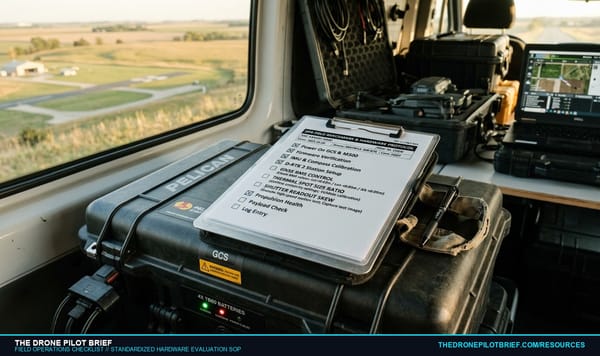
The DPB Field Benchmark SOP: Pre-Flight Geodetic & Sensor Verification Checklist
Never fly an unverified payload. Here is the standardized 10-point field checklist used by the DPB Field Lab to verify GNSS RTK integer fixes, radiometric thermal calibration, and shutter readout skew....

High-Wind Envelope Modeling: Ground Speed vs. Airspeed and the Physics of Headwind Battery Depletion Curves
Flying downwind is effortless; returning against a 25-knot headwind spikes amp draw exponentially. Here is the aerodynamic drag math and battery depletion curve that causes sudden forced landings�and how to calculate your true point of no return....

Standard Cockpit Callouts: Crew Resource Management for Two-Person Remote Pilot Teams
Crew miscommunication is the silent driver of enterprise drone accidents. Here is the standardized verbal callout protocol between Remote Pilot in Command (RPIC) and Visual Observer (VO) that prevents airspace conflicts and collision hazards....
Get The Preflight
The weekly operational-intelligence briefing for drone pilots. Filtered down to what actually matters before your next mission.