
Updated: 3 September 2026
The Brief
Remote ID is not new. 14 CFR Part 89 has required a broadcast (or a FRIA) for registered and registration-required unmanned aircraft since 16 September 2023. What changed in 2026 is how FAA handles alleged violations: most UAS cases that used to be eligible for informal compliance action now go to legal enforcement, and a separate settlement policy — DETER — offers some first-time individual operators a faster, reduced-penalty path.
DETER is not a detection network. It is an enforcement-settlement policy.
Flight-Ready Breakdown
Operational EnforcementWhat Changed
On 21 January 2026 FAA issued Compliance and Enforcement Bulletin No. 2026-1, which, as later described in the DETER notice, requires legal enforcement for UAS operations that endanger the public, violate established airspace restrictions, or further another crime. On 17 April 2026 FAA published the Drone Expedited and Targeted Enforcement Response (DETER) Program in the Federal Register (91 FR 20578). Eligible first-time individual operators can accept a Violation Notice — pay a reduced civil penalty, serve a reduced suspension, and complete listed corrective action within 10 days — or decline and face the ordinary legal-enforcement process.
Who is Affected
Anyone operating an unmanned aircraft that is registered or required to be registered under 14 CFR parts 47 or 48, including Part 107 flights of any weight and recreational flights of aircraft over 0.55 pounds (250 grams). Recreational aircraft at or under 0.55 pounds that are not registered are outside Part 89. Part 107 work is not.
Why it Matters
A RID failure is no longer something you should expect to close with a warning and a class. DETER can close a first-time operational case quickly, but accepting the notice is a finding of violation, waives appeal, and uses up the one-time eligibility. Locations and times not covered by DETER still go through the full civil-penalty or certificate-action process. The notice does not publish a single RID fine schedule; the amount, if any, is the one printed on your Violation Notice.
Before Next Mission
Confirm the aircraft (or broadcast module) serial in FAADroneZone matches the hardware. Confirm the broadcast is actually on from takeoff to shutdown. If you use a broadcast module, you must be able to see the aircraft the entire flight. If the broadcast dies in the air, land as soon as practicable. The only routine way to fly without RID equipment is inside an FAA-recognized identification area, in visual line of sight, staying in the FRIA. If the aircraft has RID, it must keep broadcasting even inside a FRIA.
What Not to Assume
Do not assume Class G, rural, or “just a quick job” is exempt. Do not assume DETER is a nationwide automated sensor grid, or that it applies to every violation, every location, or a second offense. Do not assume a reduced DETER penalty is the statutory maximum, or that declining DETER means the case goes away.
What the Rule Actually Requires
Part 89 applies to persons operating unmanned aircraft registered or required to be registered, and to foreign civil UA in the U.S. After 16 September 2023, you comply by:
- a standard Remote ID aircraft that broadcasts from takeoff to shutdown, or
- an FAA-accepted broadcast module (and you must keep the aircraft in sight), or
- staying inside a FRIA, in visual line of sight.
ADS-B Out does not satisfy Part 89. Home-built and sub-0.55 lb production exceptions in subpart F are production rules; they do not give a Part 107 operator a free pass to skip registration or RID.
What DETER Actually Is
The 17 April 2026 notice is a settlement policy, effective that day. FAA sends a Violation Notice by FedEx and email. You have 10 days to accept: pay.gov, possible certificate surrender for the stated suspension, listed corrective action, and a waiver of appeal. Decline, and FAA proceeds with ordinary legal enforcement. Miss the 10 days after electing DETER, and FAA may do the same.
Eligibility is narrow: individuals, first-time UAS violators, once. FAA chooses locations and times; it will start where UAS traffic is high. It will not use DETER for alcohol/drugs, weaponized UAS, unrelated criminal activity, TFRs under § 91.141, particularly egregious conduct, or cases showing a lack of qualifications to hold a remote pilot certificate.
The January bulletin is why “educational only” is the wrong mental model for 2026. The April notice is why “they built a municipal radar platform called DETER” is also the wrong model.
Bottom Line
Broadcast, or fly the FRIA rules. Treat 2026 enforcement as legal process, not a newsletter warning. If a Violation Notice arrives, read the 10-day clock and the waiver before you sign.
Sources
- • 14 CFR Part 89: Remote Identification of Unmanned Aircraft — https://www.ecfr.gov/current/title-14/chapter-I/subchapter-F/part-89
- • FAA: Remote Identification of Drones — https://www.faa.gov/uas/getting_started/remote_id
- • FAA: Aircraft Registration (UA; 0.55 lb recreational exception) — https://www.faa.gov/licenses_certificates/aircraft_certification/aircraft_registry/ua
- • Federal Register: Drone Expedited and Targeted Enforcement Response (DETER) Program, 91 FR 20578 (17 Apr 2026) — https://www.govinfo.gov/content/pkg/FR-2026-04-17/html/2026-07585.htm
The Drone Pilot Brief does not accept payment for editorial coverage. This is not legal advice. The Federal Register text and Part 89 control.

Related Briefs

The Digital Tollbooth: Inside Proposed Part 146 and the Corporate Battle to Control Low-Altitude Airspace
While the drone industry watches Part 108, the real business model is quietly unfolding in proposed Part 146. Here is how Automated Data Service Providers will gate, monitor, and monetize low-altitude commercial flight....

California’s 400-Foot Stadium Drone Bill Reaches the Governor: What It Means for Event Airspace
California lawmakers passed AB 2113, establishing a $500 fine for flying within 400 feet of outdoor concerts and sporting events. With Governor Newsom facing a September 30 deadline, the bill reignites the legal battle over federal airspace preemption....
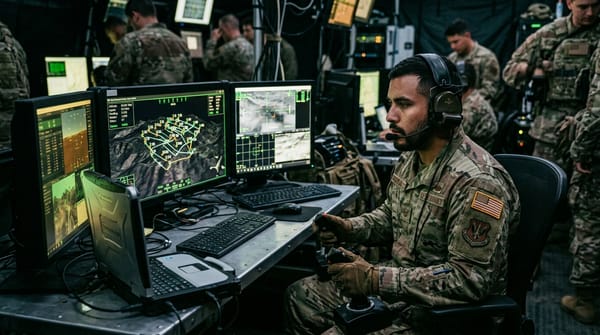
Gravity for U.S. Military Drone Operator Assessment
USNDA and OUSW(R&E) establish National Drone Wars as the central venue for evaluating U.S. military drone operator proficiency, signaling a major shift in UAS modernization, procurement, and doctrine....
Get The Preflight
The weekly operational-intelligence briefing for drone pilots. Filtered down to what actually matters before your next mission.