
- Four Ps: person, platform, process, payload
- Five Ds: detect, deny, disrupt, defeat, discipline
The Brief
Joint Interagency Task Force 401 published Small Drones, Big Problems: A First Principles Approach to Countering-UAS, dated 18 June 2026 and released publicly in early July. It is a 90-page orientation document for warfighters, federal agencies, and local law enforcement. Brig. Gen. Matthew Ross, JIATF 401’s director, describes it as a common foundation — not a technical manual and not doctrine.
Flight-Ready Breakdown
Threat AssessmentWhat Changed
DoD’s counter-drone task force put a shared vocabulary in one place. The Four Ps are how to assess a threat (who is flying, what airframe, how it is controlled, what it is for). The Five Ds are a sequence in which kinetic defeat is last, not first. Denial — making yourself uninteresting or hard to see — is the step the handbook says defenders skip.
Who is Affected
Public-safety UAS programs, critical-infrastructure security, and Part 107 operators flying near sites that already attract law-enforcement attention. This is not a new FAA rule and not a new Remote ID requirement.
Why it Matters
A first-principles handbook is not authority to jam, seize, or shoot a drone. Most of the defeat tools it describes are restricted to the military and to agencies with statutory C-UAS authority. For a private operator the useful takeaway is simpler: Remote ID on, authorization in the folder, and do not treat “I was below 400 feet” as invisibility.
Before Next Mission
If you fly near a prison, airport, stadium, or other covered site, assume detection exists. Carry the authorization you actually hold. Do not assume a handbook equals a local C-UAS program.
What Not to Assume
Do not assume this document created SLTT C-UAS authority. Congress did that separately in the SAFER SKIES Act (FY2026 NDAA, P.L. 119-60), implemented by a DOJ/DHS interim final rule effective 1 July 2026 (91 FR, 6 July 2026). That rule is a certification and technology-list framework for trained agencies — not “AeroScope and Dedrone are now scanning every metro.” Do not assume the handbook’s vignettes (Langley-Eustis 2023, Ukraine, Operation Epic Fury) are instructions for a Part 107 job.
Sources
- • JIATF 401: Small Drones, Big Problems: A First Principles Approach to Countering-UAS (18 June 2026) — https://www.suasnews.com/wp-content/uploads/2026/07/SMALL-DRONES-BIG-PROBLEMS-A-FIRST-PRINCIPLES-APPROACH-TO-COUNTER-UAS.pdf
- • Military Times: Daniel Terrill, “Inside the Pentagon’s new handbook on countering drones,” 10 July 2026 — https://www.militarytimes.com/industry/techwatch/2026/07/10/inside-the-pentagons-new-handbook-on-countering-drones/
- • DOJ/DHS IFR: Counter-UAS Authority for SLTT Law Enforcement, 91 FR (6 July 2026), 2026-13609 — https://www.govinfo.gov/content/pkg/FR-2026-07-06/html/2026-13609.htm
The Drone Pilot Brief does not accept payment for editorial coverage.

Related Briefs

The Digital Tollbooth: Inside Proposed Part 146 and the Corporate Battle to Control Low-Altitude Airspace
While the drone industry watches Part 108, the real business model is quietly unfolding in proposed Part 146. Here is how Automated Data Service Providers will gate, monitor, and monetize low-altitude commercial flight....

California’s 400-Foot Stadium Drone Bill Reaches the Governor: What It Means for Event Airspace
California lawmakers passed AB 2113, establishing a $500 fine for flying within 400 feet of outdoor concerts and sporting events. With Governor Newsom facing a September 30 deadline, the bill reignites the legal battle over federal airspace preemption....
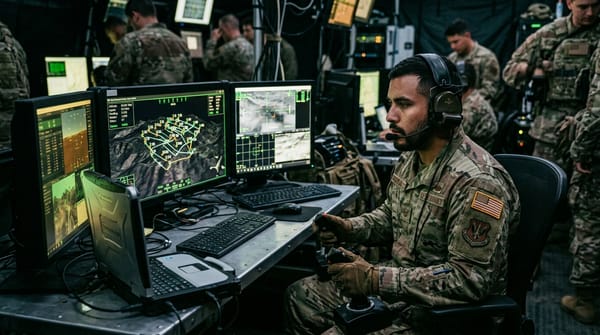
Gravity for U.S. Military Drone Operator Assessment
USNDA and OUSW(R&E) establish National Drone Wars as the central venue for evaluating U.S. military drone operator proficiency, signaling a major shift in UAS modernization, procurement, and doctrine....
Get The Preflight
The weekly operational-intelligence briefing for drone pilots. Filtered down to what actually matters before your next mission.