
The Brief
Maj. Rachel Martin, director of the U.S. Army’s Unmanned Advanced Lethality Course, told Business Insider (17 July 2026) that the biggest remaining skill gap in the course is learning to fly with goggles: the student looks through a small forward camera and does not get the physical cues a crewed aircraft gives. That is a training observation from one Army course. It is not a neuroscience paper.
Flight-Ready Breakdown
Training MethodologyWhat Changed
Nothing in civil regulation. An Army instructor described why FPV feels different from crewed flying and from line-of-sight UAS: no seat-of-the-pants feedback.
Who is Affected
Soldiers in that course, and civil FPV pilots who already know a simulator is where you fail cheap. It does not change Part 107.
Why it Matters
The useful claim is narrow and true enough to fly from: FPV is a visual-motor skill with no vestibular confirmation. Crewed time can be a handicap if you wait for a sensation that never arrives. Martin’s point is the goggles, not a metaphor about dismantling identity.
Before Next Mission
If you are new to FPV, log stick time in a simulator until the basic maneuvers are boring, then prove them on the aircraft you will actually fly. That is the same gate as DPB’s FPV simulator piece. Do not treat an Army lethality course as a civil syllabus.
What Not to Assume
Do not assume manned-pilot hours transfer. Do not assume DPB measured “physical swaying” in a simulator — we did not. Do not assume a speed, a required hour count, or a “neural adaptive” training product. Those were not in the interview as used here.
Sources
- • Business Insider: “US Army Soldiers Training Brains to Fly Drones, Different to Aircraft,” 17 July 2026 — https://www.businessinsider.com/us-army-soldiers-training-brains-fly-drones-different-to-aircraft-2026-7
The Drone Pilot Brief does not accept payment for editorial coverage.

Related Briefs
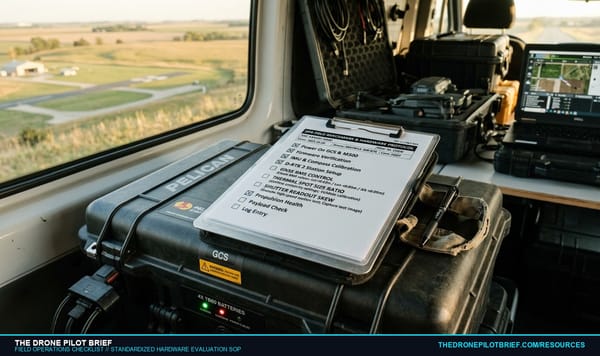
The DPB Field Benchmark SOP: Pre-Flight Geodetic & Sensor Verification Checklist
Never fly an unverified payload. Here is the standardized 10-point field checklist used by the DPB Field Lab to verify GNSS RTK integer fixes, radiometric thermal calibration, and shutter readout skew....
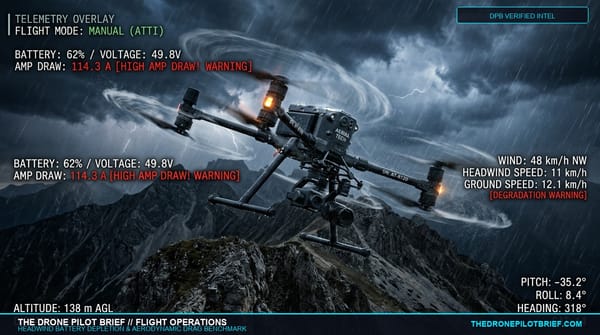
High-Wind Envelope Modeling: Ground Speed vs. Airspeed and the Physics of Headwind Battery Depletion Curves
Flying downwind is effortless; returning against a 25-knot headwind spikes amp draw exponentially. Here is the aerodynamic drag math and battery depletion curve that causes sudden forced landings�and how to calculate your true point of no return....

Standard Cockpit Callouts: Crew Resource Management for Two-Person Remote Pilot Teams
Crew miscommunication is the silent driver of enterprise drone accidents. Here is the standardized verbal callout protocol between Remote Pilot in Command (RPIC) and Visual Observer (VO) that prevents airspace conflicts and collision hazards....
Get The Preflight
The weekly operational-intelligence briefing for drone pilots. Filtered down to what actually matters before your next mission.